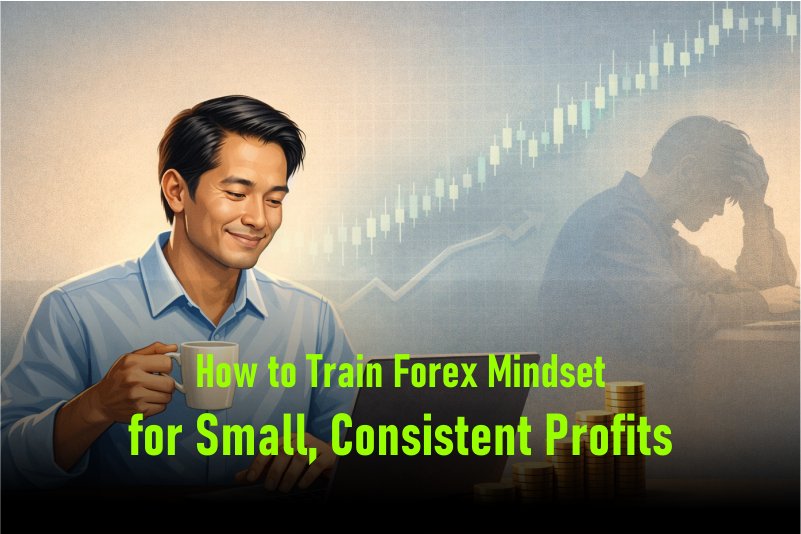
Many forex traders quit not because their strategy is bad, but because their mindset collapses first.
Their account is still safe, their system still makes sense, yet a quiet thought starts to grow:
“Why is the profit so small?”
That thought slowly turns into greed.
Greed leads to overtrading, emotional decisions, unnecessary losses, and eventually mental exhaustion.
Ironically, in professional trading, small but consistent profits are a sign of a mature mindset.
This article will explain how to train forex mindset to be satisfied with small but consistent profits, in a realistic, human, and practical way.
Why Mindset Is the Real Deciding Factor in Forex Trading
Forex is not about who can read charts better.
Forex is a game of decision-making under emotional pressure.
Every price movement triggers emotions:
- Hope when a trade is in profit
- Fear when the market moves against you
- Temptation to break your trading plan
Without a trained mindset, traders tend to:
- Enter the market too often
- Increase lot size emotionally
- Feel dissatisfied with small gains
That is why learning how to train forex mindset is just as important as learning technical analysis.
The Common Mistake: Thinking Small Profits Mean Failure
Many beginner and intermediate traders believe:
“If the profit is small, what’s the point of trading?”
This mindset is dangerous.
In professional trading, small consistent profits are the foundation of survival.
Traders who chase big profits often:
- Lose patience
- Fall into FOMO
- Become psychologically inconsistent
On the other hand, traders who are satisfied with small profits tend to be:
- More disciplined
- Emotionally calmer
- Much more consistent over time
Training your forex mindset means redefining what success really means.
How to Train Forex Mindset to Be Satisfied with Small but Consistent Profits
1. Shift Your Target: From “Big” to “Correct”
Instead of aiming for:
- 100 pips per day
- 10% per week
Shift your focus to:
- Following your trading plan
- Entering only valid setups
- Exiting according to risk management
This simple shift moves your attention from results to process.
It is the first and most important step in training a healthy forex mindset.
Small profits earned from correct execution feel safer, calmer, and more sustainable.
2. Understand That Consistency Beats Brilliance
A “brilliant” trader may make a big profit once or twice.
A consistent trader makes small profits over and over again.
Mathematically:
- A steady +1% over time is far healthier
- Than +20% followed by emotional losses
Once you understand this, your mindset naturally becomes more accepting of small profits as part of a long-term trading strategy.
3. Lower Your Expectations of the Market, Raise Them for Yourself
The market owes us nothing.
It does not promise big profits every day.
What you can control is:
- Discipline
- Risk management
- Emotional responses
One powerful way to train your forex mindset is to stop demanding results from the market and start demanding consistency from yourself.
The Professional Trader’s Mindset: Calm, Patient, and Non-Greedy
Professional traders rarely look excited or emotional.
They tend to:
- Wait more
- Trade less
- Accept reasonable outcomes
Not because they dislike big profits, but because they understand:
“Survival matters more than excitement.”
This mindset does not appear overnight.
It is shaped through experience, mistakes, and the realization that greed is the biggest enemy of consistency.
Small but Consistent Profits = Healthy Trading
If you can:
- Close a trade with a small profit without regret
- Avoid re-entering just because of FOMO
- Close your chart feeling “enough”
That is a clear sign your trading mindset is leveling up.
Training forex mindset is not about eliminating emotions, but managing them wisely.
Practical Mental Exercises for Forex Traders
Trading Journal (Non-Negotiable)
Record:
- Entry reasons
- Exit reasons
- Emotions before and after trading
Not to judge yourself, but to recognize emotional patterns.
Limit Trading Frequency
The more often you trade:
- The higher the mental pressure
- The greater the chance of impulsive decisions
Fewer trades often lead to a calmer and clearer mindset.
Practice Closing Trades Early
Train yourself to feel satisfied.
This exercise is surprisingly effective in building comfort with small but consistent profits.
From Emotional Trader to Disciplined Trader
Mindset change does not happen overnight.
But every time you:
- Avoid overtrading
- Refuse revenge trading
- Control greed during profits
You are actively training your forex mindset.
Good trading feels:
- Calm
- Boring
- Undramatic
And that is exactly where steady account growth happens.
Conclusion: Trading Is Not About Ego, but Endurance
If you want to last in forex trading, stop chasing adrenaline.
Start chasing consistency and emotional stability.
By understanding how to train forex mindset to be satisfied with small but consistent profits, you protect not only your account, but also your:
- Focus
- Mental health
- Long-term decision-making
Because in trading, the winners are not the bravest —
they are the most patient.
Replace the promise of consistent profits with a consistent process
It is tempting to set a daily dollar goal and feel that a small profit is a failure. Markets do not provide a fixed number of good opportunities on demand. A more useful daily scorecard asks whether you respected your allowed instruments, position-size budget, stop-loss rules and trading hours. A day with no trades may reflect good selectivity rather than missed income.
Suppose a trader takes 20 hypothetical trades and wins 12. A 60% win rate tells us little unless we also know the average win, average loss and costs. If the average winner is $8 and the average loser is $15, the gross outcome is 12 × $8 minus 8 × $15, or a $24 loss before costs. The arithmetic matters more than the reassuring feeling of ‘winning most days’.
Track emotions as observable behaviours
Rather than writing only ‘I felt greedy’, record what you did: increased size after a loss, moved a stop farther away, entered without the planned signal or checked the account constantly. These are events you can count. After 30–50 demo decisions, review which behaviour repeatedly preceded the most expensive mistakes. The sample still does not establish long-term statistical reliability, but it can reveal process errors.
Use the plan-review guide to build a weekly checklist, and read the overtrading explainer before interpreting a streak of wins as proof that larger positions are justified.
Independent sources: CFTC advisory on leverage and forex trading.
About the Author