Independent editorial guide | Reviewed 10 October 2026 | For education, not personalised investment or legal advice.
Forex is easy to advertise online. A trading platform can offer an Arabic interface, deposits in Saudi riyals, an ‘Islamic’ account and high leverage from almost anywhere. None of those features alone proves that the provider is authorised to offer the advertised service to someone in Saudi Arabia. Before risking savings, traders need to distinguish ordinary bank foreign exchange, investment services and speculative leveraged products, and check which legal entity is actually responsible.
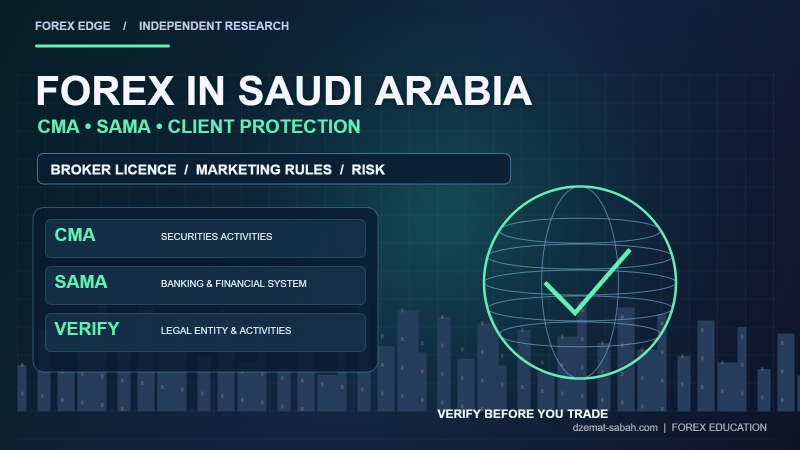
This is a practical guide to reading official Saudi sources: the Capital Market Authority (CMA) for regulated securities activities and the Saudi Central Bank (SAMA) for banking, payment and other activities within its remit. It does not provide a general declaration that all forms of retail forex trading are either permitted or prohibited. Product type, solicitation arrangements, authorisation, local law and the customer’s position all matter.
Why ‘forex’ can describe different financial activities
A traveller exchanging Saudi riyals for dollars at a licensed bank or currency-exchange provider is undertaking a different transaction from a speculative cash-settled forex CFD on a leveraged online platform. Similarly, a financial institution hedging commercial exposure through a bank may use a different contract and regulatory framework from a retail customer responding to a social-media trading promotion.
Do not use one vague term—’forex is legal’—as your entire compliance analysis. Ask what asset or claim you actually own, whether there is physical delivery, what happens when the position is closed, how margin is funded and who serves as the counterparty. These details should be defined in the client agreement.
Saudi CMA: securities activities, regulated firms and unauthorised providers
The Saudi Capital Market Authority (CMA) supervises activities within its capital-markets mandate and makes information about licensed institutions and unauthorised activities available to the public. Its public warnings encourage investors to check authorisation before dealing with firms that offer regulated securities activities. A licence for one investment activity is not interchangeable with permission for every product, customer or marketing channel.
Begin at the Saudi CMA official website and follow its links for authorised persons and warnings. The CMA also publishes a list of companies not licensed to carry out securities activities. That list is not necessarily exhaustive; absence of a firm from it should never be used as proof of authorisation.
Saudi Central Bank (SAMA) and cross-border forex promotions
SAMA’s rulebook includes a document addressing non-resident forex companies conducting or promoting certain banking-related activities within the Kingdom without appropriate licensing and arrangements. It discusses marketing, local intermediaries and the use of banking relationships to channel activity. This is an important reason not to assume that an offshore platform’s ability to receive a transfer makes the underlying service locally authorised.
Read the source directly: SAMA’s guidance on non-resident forex companies. The document is concerned with particular activities and financial-sector relationships. Do not extrapolate it into a simplified rule about every form of foreign currency transaction or treat the banking regulator and capital-markets regulator as if they had identical mandates.
How to interpret an overseas broker claiming an international licence
Some forex platforms promote authorisation from a regulator outside Saudi Arabia and make their service available in Arabic. Such a licence can be genuine yet still not establish the provider’s rights to promote, solicit or conduct a regulated service within the Kingdom. It also may not provide the same complaint, compensation or insolvency protections a locally regulated customer would expect.
Identify the legal entity with which the account will be opened—not merely the brand on the landing page. Check its authorisation with the claimed overseas regulator, then investigate the legal basis for serving Saudi residents through official Saudi sources or qualified professional advice. Beware of a salesperson switching the contracting company after you have completed registration.
A broker verification walk-through
Imagine ‘Desert Markets’ offers 1:500 leverage, a zero-swap account and one-click deposits. First, request the legal name of the counterparty, company number and governing jurisdiction. Second, ask what trading product the account actually uses: deliverable FX, futures, CFDs or another instrument. Third, match the overseas licence number and activity to the entity in its official register. Fourth, check the relevant CMA or SAMA information about whether that activity may be offered to your location. Fifth, review the agreement on fees, margin calls, withdrawals and disputes.
If a company or agent says ‘We are officially authorised because we work with a Saudi payment partner’, request the regulatory basis in writing. A payment channel or a locally accessible website does not automatically transform an unauthorised investment service into a locally licensed one. If you cannot identify the contracting entity or permitted activity, suspend any deposit rather than treating the mystery as a minor paperwork issue.
Leverage and margin: what a small deposit can expose you to
A common promotional appeal is to control a large nominal position with a small amount of margin. For example, on a hypothetical $10,000 notional position at 1:50 leverage, the simplified initial margin requirement would be $200. A 2% adverse movement of the notional exposure represents roughly $200 before dealing costs. Real losses may be affected by margin rules, liquidity gaps, financing costs and the broker’s execution policies.
This illustration shows why available leverage and financial suitability are different issues. A high maximum leverage ratio is not evidence of a superior broker or a sound trading strategy. Position size, stop distance, total USD exposure and the possibility of worse-than-expected fills require independent checks. Do not use borrowed money or essential household funds for highly leveraged speculative trades.
Islamic and swap-free accounts: check the entire contract
A platform may describe an account as Islamic or swap-free, but that does not resolve every legal, economic or religious consideration. Some products are CFDs without delivery of the underlying currencies. Fees can also reappear under administrative charges or holding-period rules. The relevant question for a religious assessment is not just whether overnight swap is listed as zero.
Ask what the instrument legally represents, whether there is physical exchange or settlement of differences, whether financing exists, what happens with leverage and how any alternative charges are calculated. A qualified specialist in Islamic finance can review the actual agreement. Our Arabic swap-free account explainer lists questions to ask without issuing a religious ruling.
Common warning signs in forex and AI-bot promotions
Be sceptical of fixed monthly income, profit guarantees, screenshots without independently verifiable account statements, messaging groups that pressure you to send money immediately, and demands for extra ‘tax’ or ‘unlock’ payments to release withdrawals. Some campaigns claim artificial intelligence makes losses impossible. The CFTC’s public advisories warn that AI-branded trading bots cannot predict sudden market events and that guaranteed-return claims are common fraud signals.
Do not transfer funds to a private individual’s account based on an intermediary’s message. Never share password, OTP or remote-control access with a salesperson. Cross-check all official contact details independently and record the name, date and documentation of any claims you plan to verify.
Practical checklist and related reading
Before considering any service, document seven things: the company’s full legal name; the exact product; the regulator and authorised activities; the basis for solicitation to your country; the client agreement; trading and withdrawal fees; and the official route for complaints. Verify the licence on the regulator’s own website on the date you act and monitor later changes if you remain a customer.
Continue to the Arab-world forex overview and the UAE regulatory comparison to see why the same brand may be treated differently across borders. Read the AI forex pillar before evaluating bot-profit advertisements. Forex Edge is an independent educational publisher and not a Saudi regulator, licensed adviser or broker.
Frequently asked questions
Is retail forex trading automatically permitted in Saudi Arabia?
There is no safe blanket answer without identifying the specific product and how it is offered. Check the relevant CMA and SAMA frameworks and current authorisations.
Does a foreign broker’s overseas licence make it Saudi-regulated?
No. An overseas licence applies to its stated scope; it does not automatically confer local authorisation to solicit or conduct every activity in Saudi Arabia.
Does a Saudi bank-transfer option prove a trading platform is licensed?
No. Payment availability and investment-service authorisation are separate questions.
Does a zero-swap Islamic account eliminate the risks of forex?
No. Leverage, spread, counterparty risk, settlement terms and the possibility of a trading loss remain relevant.
Official sources and further reading
- Saudi CMA — Official Website
- Saudi CMA — Unlicensed Companies
- Saudi CMA — Warning about Unauthorised Securities Businesses
- Saudi Central Bank SAMA — Non-Resident FOREX Companies Rulebook
- Saudi Central Bank — Home and Consumer Information
- CFTC — AI trading bot scams
- CFTC — Retail Forex Frauds
Disclosure: Forex and leveraged CFDs carry substantial risk of loss. A broker authorisation must be checked by legal entity and service, and no algorithm or trading system guarantees results. This is not an endorsement of a broker, regulator or investment product. Read our risk disclosure and editorial standards.
About the Author