Independent editorial guide | Reviewed 10 October 2026 | For education, not personalised investment or legal advice.
Search for “AI forex trading” and you will find two very different promises. One is a trading bot that supposedly predicts every reversal. The other is a set of tools for doing research more carefully: checking price data, making strategy rules explicit, reviewing trade logs and finding gaps in a backtest. The second use case is much more defensible. Artificial intelligence can speed up parts of a research process, but a faster research process does not prove that a strategy will make money.
This guide is written for traders who want a useful workflow rather than an unverified signal service. We will design a simple EUR/USD idea, turn it into testable rules, separate research from execution, calculate risk, account for spread and slippage, and describe what would justify moving from historical tests to a demo account. All price levels and trading results are hypothetical illustrations. No live orders or independently audited profitability study were performed for this article.
What counts as AI in forex trading?
The term covers several different technologies. A general-purpose language model can summarize documents, critique a trading plan and explain code. A statistical machine-learning model can learn relationships from labeled historical data, provided the labels and test design are sensible. A rule-based expert advisor (EA) can execute fixed instructions without using machine learning at all. A broker’s risk engine may apply prediction or anomaly detection, but a retail trader rarely sees enough detail to evaluate those systems.
Confusing these categories leads to poor decisions. A prompt that asks ChatGPT for a buy signal is not the same as a tested model, and an MT4 EA that buys when two moving averages cross is automated trading but not necessarily AI. Start by writing down the exact task you want automated: explaining data, generating hypotheses, checking code, identifying unusual spread behaviour, or placing orders. Then ask how you will detect failure and who is accountable for it.
The five-part workflow: research, data, rules, tests and risk
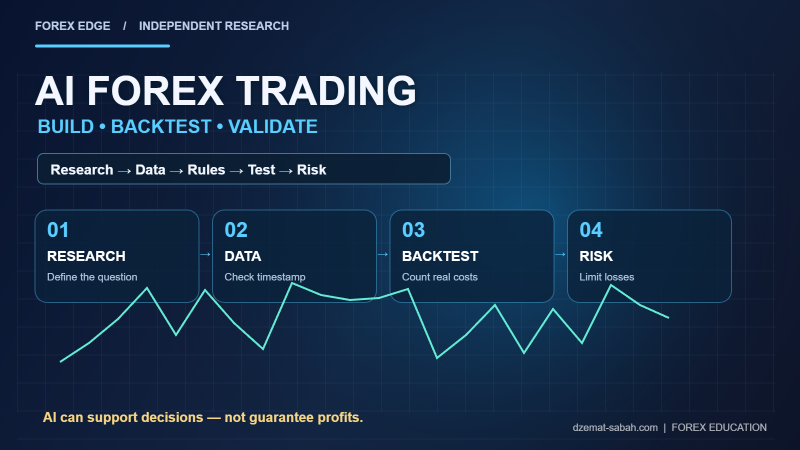
Treat AI as one component inside a research workflow rather than as the source of truth. A useful sequence is: (1) choose a market question, (2) collect historical bid/ask quotes and a timestamped event calendar, (3) write unambiguous trade rules, (4) backtest and validate on unseen periods, and (5) forward-test execution and risk on a demo account. At each transition, record the exact dataset and code version used, so you can reproduce a result rather than relying on screenshots.
AI can help draft a data-cleaning checklist and highlight missing definitions, but it cannot repair unavailable market information or verify a broker’s fills without the underlying evidence. Compare your results with a simple baseline strategy and with doing nothing. If the fancy model underperforms a rule-based baseline after transaction costs, adding complexity is not a reason to trade it live.
Step 1 — turn a market idea into a falsifiable hypothesis
Consider an idea often discussed by retail traders: EUR/USD may experience a volatility expansion after London becomes active, especially if price has been confined to a narrow earlier range. Instead of writing ‘buy the London breakout’, define the session using the correct local date and daylight-saving rules, the time window from which the range is calculated, a measurable breakout condition, and the point that invalidates it. Decide in advance whether you are testing breakouts in both directions or only in the prevailing trend.
For illustration, a researcher could define an Asian range between specified UTC hours, require an H1 close beyond its high or low, and permit entry only after a retest on M15. The stop might sit beyond the retest extreme, and the test could forbid entries during a predetermined news window. Those rules still contain choices that must be specified: minimum candle size, maximum spread, distance to the stop and time-based cancellation. This is a hypothesis to evaluate, not a signal to buy EUR/USD now.
Step 2 — build a dataset that does not look into the future
The quality of a trading test depends heavily on when information became available. A macroeconomic data point may be labeled with the month it describes, but traders could not see its published value until a later release date. A candle is not complete before its close. A model trained using a revised economic series, an incomplete candle or tomorrow’s price in today’s features has contaminated its historical test.
Separate a development period from a later holdout period that you do not repeatedly tune against. For time series, do not shuffle observations into random training and test folds as if market returns were independent survey responses. Use a chronological split or a carefully designed walk-forward procedure, then record gaps between training and test windows where appropriate. QuantConnect’s research guide describes overfitting and look-ahead bias; the underlying lesson applies whether you use machine learning or simple moving-average rules.
Step 3 — model the cost of every trade
A promising gross profit line may disappear once the cost of execution is subtracted. In a simplified EUR/USD example, suppose a strategy takes 100 hypothetical trades. If 48 winners average +1.2R and 52 losers average −1R, the gross outcome is 48 × 1.2 − 52 = +5.6R. If all-in dealing costs average 0.08R per round trip, total costs consume 8R and the net result becomes −2.4R. This is not a measured market result; it shows why a positive gross backtest does not establish a positive net strategy.
| Item | Illustrative outcome |
|---|---|
| Trades | 100 |
| 48 winners at +1.2R | +57.6R |
| 52 losers at −1R | −52.0R |
| Gross expectancy total | +5.6R |
| Average costs 0.08R × 100 | −8.0R |
| Net test result | −2.4R |
Use historical bid/ask spreads where possible, instrument-specific contract values, commissions, financing charges and realistic slippage scenarios. A stop-loss may execute beyond its level in a price gap. Backtests should penalize the strategy if orders would be missed, delayed or filled at worse prices, and should distinguish simulated results from genuine live transaction records.
Step 4 — measure drawdown and stability, not just win rate
Win rate alone hides the size of losses. Study average winning and losing trades, expectancy after costs, maximum drawdown, longest losing streak, trade count and sensitivity to a small change in parameters. A strategy that only works when an indicator uses 19 periods, but fails at 18 and 20, may be fitting noise. The same is true of an AI classifier selected after trying hundreds of settings on the same historical dates.
Stress-test across different volatility periods and trading sessions. Change the spread assumption, delay entry by one bar, and examine performance if several related currency positions lose together. Keep a separate record of out-of-sample and paper-trading performance instead of presenting the best historical curve as a realistic income forecast.
Step 5 — check position sizing before a demo trade
Suppose your demo account has $1,500 and a purely illustrative risk budget of 0.5% per trade: $7.50. If your EUR/USD stop is 25 pips away and a full standard lot has an approximately $10-per-pip value in a USD account, the theoretical size is $7.50 ÷ (25 × $10) = 0.03 standard lot, before dealing costs. If the instrument, contract specification or account currency differs, the calculation must be redone.
An AI assistant may explain this formula and catch a missing input, but you must verify the pip value, lot step, stop-loss availability and actual margin requirements in your brokerage platform. Never let a generative model freely select leverage or modify a live order without hard limits and a human check. Also calculate total exposure when several trades depend on the same currency moving in one direction.
A prompt that acts as an independent research reviewer
Example prompt: “I am testing a demo-only EUR/USD London-breakout strategy. The rules, quotes, commission schedule and results are provided below. Identify ambiguous rules, any possible look-ahead bias, missing timestamps, uncounted spreads or fees, and reasons the result might fail out of sample. Do not invent additional market data or provide a live buy/sell signal. Separate observations from assumptions, and list the checks needed before forward testing.”
This is more useful than asking a chatbot for a guaranteed profitable algorithm. You can also ask it to build a reproducibility checklist, explain an unfamiliar backtest statistic or summarize your own journal after personal identifiers are removed. For more examples, read our ChatGPT research and journal guide and the practical system-building case study.
A realistic 30-day implementation plan
Week one: define one strategy and collect reliable data. Week two: build a transparent rule-based baseline and a cost-aware backtest. Week three: evaluate the holdout period and deliberately test worse execution conditions. Week four: observe a demo account without changing the rules after every result. Record every skipped setup, not just successful entries. If you lack sufficient data, the honest outcome of the project may be “no evidence of an edge.”
The CFTC has warned that scammers sell AI bots promising extraordinary returns and sometimes fabricate account balances. Before subscribing to an AI trading service, check its provider, trading permissions, verifiable track record, fees and withdrawal terms. A credible plan should show how it can lose money. Connect this pillar with backtesting methodology, the limitations of forex robots, position sizing and our editorial policy.
Frequently asked questions
Can AI reliably make me profit from forex?
No model can guarantee profitable trades. AI may improve research efficiency or enforcement of tested rules, but markets and execution conditions change and losses remain possible.
Do I need to code to use AI for trading?
No for research checklists and journal reviews; yes or a carefully audited tool for custom backtesting and automated execution. Use demo accounts and verify calculations.
Is ChatGPT an Expert Advisor (EA)?
No. An EA is software that implements trading instructions in a trading platform. ChatGPT can help review ideas or generate draft code, but it does not automatically have authenticated access to live trading.
How long should I backtest?
There is no universal number of months or trades. Aim for sufficient observations across changing market conditions, strictly separated holdout data and realistic costs; do not promote an untested result.
Official sources and further reading
- CFTC — AI Won’t Turn Trading Bots into Money Machines
- QuantConnect — Research Guide: overfitting and look-ahead bias
- QuantConnect — Reality Modeling: fees, fills, slippage
- BIS — Triennial FX Turnover Survey (April 2025)
- CFTC — Forex Frauds and risk disclosures
Disclosure: Forex and leveraged CFDs carry substantial risk of loss. A broker authorisation must be checked by legal entity and service, and no algorithm or trading system guarantees results. This is not an endorsement of a broker, regulator or investment product. Read our risk disclosure and editorial standards.
About the Author