In the modern trading world, many people are attracted to something that almost sounds like a shortcut: forex trading robots. Imagine a system that can trade automatically—analyzing the market, opening positions, and closing trades without you constantly watching the charts. It sounds appealing, doesn’t it?
This is why forex trading robots are often promoted as a solution for traders who want to profit from the forex market without monitoring it all the time.
However, behind the promise of automated profits lies an important question: can forex trading robots truly generate consistent profits, or are they simply a marketing myth?
In this article, we will explore in a relaxed yet comprehensive way what forex trading robots are, how they work, their types, and the risks you should understand before using them.
What Is a Forex Trading Robot?
Before going further, it is important to understand what a forex trading robot actually is.
Definition of a Forex Trading Robot
A forex trading robot is a computer program or software designed to execute trading transactions automatically in the forex market. These robots are often referred to as Expert Advisors (EA).
The program operates based on predefined algorithms and trading rules. When market conditions match the programmed criteria, the robot automatically opens or closes trading positions.
This means traders do not need to execute every trade manually.
Many traders use forex trading robots because they can:
- Remove emotional influence from trading
- Execute strategies consistently
- Save time monitoring the market
However, there are still important considerations before relying entirely on automated systems.
How Do Forex Trading Robots Work?
In simple terms, forex trading robots analyze market data and execute trades based on programmed rules.
Most robots rely on various technical analysis tools such as:
- Moving Average
- RSI (Relative Strength Index)
- MACD
- Support and resistance levels
- Specific price patterns
When market conditions meet the strategy criteria, the robot automatically performs actions such as:
- Opening buy or sell positions
- Setting stop loss levels
- Defining take profit targets
- Closing trades automatically
Forex trading robots are commonly used on popular trading platforms such as MetaTrader 4 (MT4) and MetaTrader 5 (MT5).
With automated systems, trading can run 24 hours a day following the global forex market without constant human intervention.
Types of Forex Trading Robots
Not all forex trading robots operate in the same way. Different robots use different trading strategies.
Understanding these types can help traders choose the right system.
Scalping Robots
Scalping robots are designed to execute many trades within a short period of time.
Their strategy is simple: capture small profits from small price movements repeatedly. These robots can open dozens or even hundreds of trades per day.
The advantage is fast profit opportunities, but they are highly sensitive to broker spreads and market volatility.
Trend-Following Robots
This type of robot follows a classic trading principle: “the trend is your friend.”
The robot identifies strong market trends and opens positions in the same direction.
This strategy is usually more stable than scalping, but it may suffer losses during sideways market conditions.
Grid Trading Robots
Grid trading robots open multiple positions at predetermined price intervals.
For example, if the price drops, the robot continues opening buy positions at different levels, expecting the market to eventually reverse.
While this strategy may generate short-term profits, it carries significant risk if the market continues moving strongly in one direction.
Martingale Robots
Martingale robots are among the most controversial types of forex trading robots.
This strategy works by doubling the lot size after a losing trade, hoping that one winning trade will recover previous losses.
The problem is that if the market continues moving against the position, the trading account may experience large drawdowns or even a margin call.
For this reason, martingale strategies are often considered high-risk.
Advantages of Using Forex Trading Robots
Despite their risks, forex trading robots offer several benefits that attract many traders.
Eliminating Emotional Trading
One of the biggest reasons traders lose money is emotional decision-making—fear, greed, or panic.
Trading robots have no emotions. They simply follow the programmed strategy.
This makes trading execution more disciplined.
24-Hour Trading Capability
The forex market operates nearly 24 hours a day.
A trading robot can stay active even when you are sleeping or busy with other activities.
This allows traders to capture opportunities across different trading sessions.
Faster Trade Execution
Speed can be crucial in forex trading.
Trading robots can open and close trades within milliseconds, something that manual traders may find difficult to achieve.
Strategy Consistency
Many traders have good strategies but struggle to follow them consistently.
Forex trading robots can execute the same strategy repeatedly without hesitation or second-guessing.
Disadvantages and Risks of Forex Trading Robots
Despite their advantages, forex trading robots also have important drawbacks that are often overlooked in promotional materials.
No Robot Can Always Be Profitable
The forex market constantly changes.
A strategy that works in one market condition may fail in another.
Therefore, no trading robot can guarantee consistent profits forever.
Overfitting Risk
Some robots are excessively optimized using historical data.
Their backtest results may look impressive, but their real performance can be very different when applied to live market conditions.
This problem is known as overfitting.
Dependence on Market Conditions
Most trading robots are designed for specific market conditions such as trending or ranging markets.
When the market environment changes dramatically, the robot’s performance may decline.
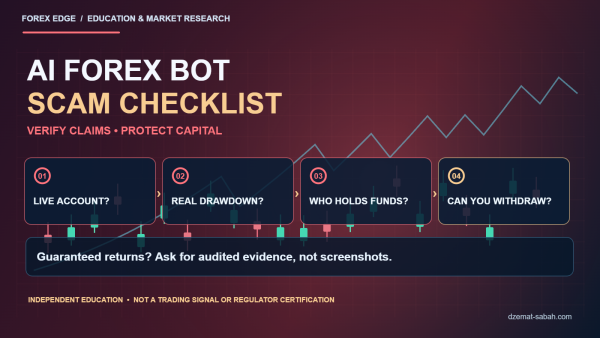
Many Scam Robots on the Market
One of the biggest issues in the trading robot industry is the presence of many products promising unrealistic profits.
Some even manipulate trading results to attract buyers.
For this reason, traders must be careful before purchasing any forex trading robot.
Are Forex Trading Robots Truly Profitable?
The honest answer is: they can be, but not always.
Forex trading robots are simply tools. Profitability depends on several factors, including:
- The trading strategy used
- Risk management
- Market conditions
- Robot configuration
- The broker used
Even a good trading robot can produce losses if it is used without proper risk management.
Therefore, it is important to view trading robots as trading tools, not automatic money machines.
How to Choose a Reliable Forex Trading Robot
If you are interested in using a forex trading robot, here are some important factors to consider.
Check the Trading Track Record
A credible robot usually provides transparent trading performance records.
Many developers share results through monitoring platforms such as Myfxbook.
This allows traders to verify real trading performance.
Avoid Unrealistic Profit Promises
If a robot claims to generate 100% profit every month with no risk, it is most likely a marketing tactic.
In trading, higher returns always come with higher risk.
Look for Backtest and Forward Test Data
A reliable robot usually provides:
These help traders evaluate potential performance.
Use a Demo Account First
Before using a trading robot on a real account, test it on a demo account.
This helps you understand how the robot works and what risks may arise.
Tips for Using Forex Trading Robots Safely
To use trading robots more safely, consider the following tips:
- Start with a small trading capital
- Avoid extreme martingale strategies
- Use a VPS for stable robot operation
- Monitor robot performance regularly
- Do not rely entirely on automation
Successful traders usually maintain control and periodically evaluate their automated systems.
Forex Trading Robots vs Manual Trading
Many traders ask: which is better—robot trading or manual trading?
In reality, both have their own advantages.
Trading robots excel in speed and consistency, while manual trading offers greater flexibility in responding to changing market conditions.
Experienced traders often combine both approaches—using robots for specific strategies while still performing manual market analysis.
Conclusion
Forex trading robots are technological tools that allow traders to automate trading activities using algorithms.
They offer benefits such as fast execution, emotion-free trading, and 24-hour operation.
However, it is important to understand that **trading robots are not instant money-making machines**.
Profitability still depends on strategy, risk management, and a trader’s understanding of the forex market.
For traders interested in using forex trading robots, the best approach is to first understand how they work, test them carefully, and maintain control over trading activities.
When used wisely, a trading robot can become a valuable tool in your trading journey.
About the Author