Independent editorial guide | Reviewed 10 October 2026 | For education, not personalised investment or legal advice.
Looking for a ‘UAE regulated forex broker’ can produce confusing results. One website may cite the UAE’s federal capital-markets regulator, another advertises a Dubai International Financial Centre (DIFC) authorisation, and a third lists an Abu Dhabi Global Market (ADGM) entity. These references can all describe real institutions, yet they are not automatically equivalent permissions to offer leveraged currency trading to every UAE resident.
A sensible starting point is the exact legal entity and product. Are you exchanging physical currency through a bank, buying a deliverable FX instrument, investing through an asset manager, or speculating in cash-settled foreign-exchange contracts for difference (CFDs)? The answer determines which disclosures and regulatory permissions matter. This guide is educational and not a legal opinion that a specific broker or trading product is permitted for any individual.
The UAE has more than one financial regulatory perimeter
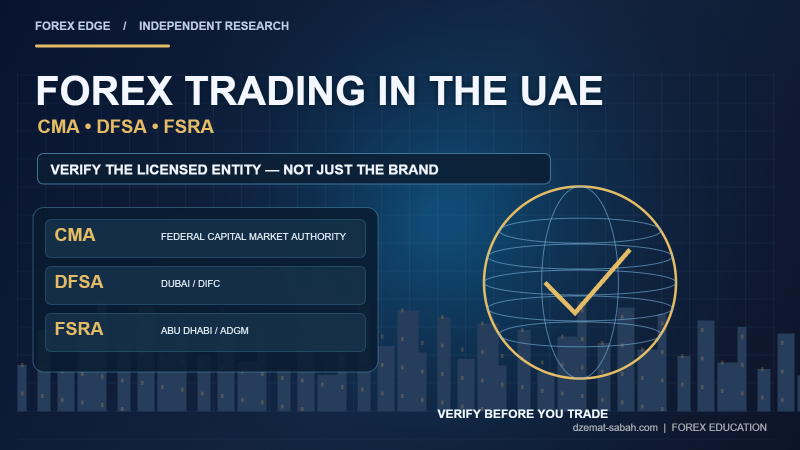
The federal Capital Market Authority (CMA), whose official portals retain some former Securities and Commodities Authority (SCA) references, publishes financial-services information, lists of licensed companies and investor warnings. This is part of the UAE’s onshore framework. Dubai’s DIFC is a separate financial free zone with the Dubai Financial Services Authority (DFSA). Abu Dhabi’s ADGM has its own Financial Services Regulatory Authority (FSRA). Banking and money-exchange services can fall within the Central Bank of the UAE’s responsibilities.
These are distinct legal frameworks rather than competing labels for one universal forex licence. Some activities may be authorised only inside a financial free zone or for specified client types; a permission to advise or introduce clients is not the same as a permission to operate as principal in every currency derivative. Read the activity and client restrictions in the regulator’s register instead of accepting a generic ‘regulated in Dubai’ badge.
The CMA and the former SCA name: check the official source
The federal authority’s current site is presented as the Capital Market Authority (CMA). Older articles, corporate documents and even some pages on the regulator’s own portal may refer to the Securities and Commodities Authority (SCA). An older acronym on a broker’s webpage is not sufficient proof of a valid licence today, and the transition should not be interpreted as authorising firms that were never licensed.
Start with the CMA open-data portal, which links to licensed companies, investor warnings and other regulatory information. Search for the exact company that will sign your agreement, compare the registered name and location, and confirm which activity the permission covers. If the official information is ambiguous, contact the regulator through a channel published on its own domain.
DIFC and the Dubai Financial Services Authority (DFSA)
The DFSA regulates financial services conducted in or from the Dubai International Financial Centre. Its mandate is geographically and legally specific. The DFSA describes its role on its official site and provides a public register of authorised entities and activities. A firm that operates a DIFC office and holds some kind of DFSA authorisation is not necessarily authorised to offer retail, highly leveraged OTC forex products to every person who can visit its website.
Use the DFSA official website to locate the Public Register. Check the legal name, current authorisation, activities, restrictions and any warning notices. Compare the contracting entity and website shown in the client agreement with the registered entity. If the brand uses a separate offshore company for your account, the DIFC registration of a related firm may not govern your contract.
ADGM and the Financial Services Regulatory Authority (FSRA)
Abu Dhabi Global Market is another international financial centre in the UAE. Its FSRA oversees authorised financial-services activities within ADGM and operates a public register that identifies the entity and the types of financial services it may provide. The register helps investors distinguish a licensed firm from a similarly named company or an unauthorised copycat.
Access the ADGM FSRA official page and follow its Public Register link. Verify that the company is actually authorised, not merely incorporated or registered in a business directory. Incorporation permits a company to exist; it does not by itself permit financial dealing, asset management or solicitation of retail leveraged trading.
A practical five-step broker-verification example
Imagine a website branded ‘GulfFX Global’ advertises a Dubai-based office, a high leverage ratio and a licence number. Do not conclude that its products are lawful before completing the checks. First, copy the exact legal name shown in the client agreement. Second, find that entity—not just a similar name—inside the claimed regulator’s official public register. Third, read which services it may undertake and for which clients. Fourth, verify that the domain and corporate details correspond. Fifth, inspect the risk disclosure and the complaints route for the entity with which you will contract.
If the broker instead transfers your application to ‘GulfFX International Ltd’ incorporated in a different country, the original Dubai licence may not apply to your account. The same brand, trading platform and support team do not create legal equivalence. Document the mismatch and ask for the actual overseas entity’s licence and whether it may lawfully serve your location. Do not send money while the basic contractual information is unresolved.
What licence language should make you ask more questions?
Marketing statements such as ‘licensed’, ‘registered’, ‘authorised introducing broker’, or ‘partner of a regulated firm’ have different meanings. An introducing arrangement may permit referring potential customers without allowing that introducer to receive client assets or execute trades. Likewise, a technology or platform-service provider may have commercial registration but no authorisation to accept investor funds.
Look for the specific permission to carry out the service being sold: forex dealing, brokerage, investment advice, portfolio management or another activity. Some instruments and clients may be subject to additional restrictions. If a promotional banner makes a broader claim than the firm’s official regulatory entry, give precedence to the register and written licence scope.
Margin, spread and withdrawal terms matter even with a valid licence
A valid licence is a necessary check in many regulated settings, but it is not a guarantee of profits or a promise that every order fills at the quoted price. A leveraged position magnifies the effect of price changes. If a broker requires 5% initial margin for a $20,000 notional position, the margin is $1,000, yet a 1% adverse movement in notional value can correspond to roughly $200 before fees. The margin is not automatically the maximum possible loss.
Compare all-in trading costs rather than minimum advertised spreads. Read the commission schedule, overnight financing rules, currency-conversion costs and withdrawal process. Inspect the margin-call and stop-out policies, and whether protections such as negative-balance limits apply to the exact client type and entity. Any assumption about an Islamic or swap-free account must be reconciled to the full contract.
Investor warnings and impersonation risks
A fraudulent operator may copy a regulator’s logo or the name of a genuinely authorised company, then substitute an unofficial website, messaging-app contact or payment account. The UAE federal authority publishes investor warnings; other regulators issue alerts about clone firms and unapproved promotions. Compare the domain, telephone and legal identity with information obtained independently from the regulator rather than from a link sent by a salesperson.
Fixed monthly returns, profit guarantees, a claim of a ‘risk-free AI trading system’ and requests to pay mysterious release fees before withdrawal are significant red flags. If you suspect impersonation, do not upload additional identity documents or send more funds while trying to resolve the discrepancy. Contact the regulator and relevant financial provider through official channels.
Practical UAE checklist and links to the regional cluster
Before considering a real-money account, collect: (1) the legal entity’s name; (2) the regulator and public-register record; (3) the exact authorised activities and allowed client category; (4) the instrument and its governing agreement; (5) margin and dealing-cost disclosures; (6) deposit and withdrawal terms; and (7) official contact details for complaints. Recheck the records close to the proposed transaction date because licence status can change.
For regional differences, continue to the Arab world forex regulation hub and the Saudi Arabia guide. General market-risk background appears in our broker-regulation explainer, while the AI trading research pillar shows how to scrutinise automated profit claims. Forex Edge is an independent educational website and not a regulatory authority.
Frequently asked questions
Is all forex trading in the UAE regulated by one authority?
No. The proper regulator depends on the activity, legal entity and relevant framework, including federal authorities and financial free zones such as DIFC and ADGM.
Does a DFSA licence mean a broker can market any CFD to anyone in Dubai?
No. Activities, product types, client categories and solicitation rules must be assessed within the precise permission and legal framework.
How can I verify an ADGM forex-related company?
Use the ADGM FSRA Public Register and compare the legal name, permissions, client categories and domain with the actual client agreement.
Does an SCA or CMA logo prove my money is protected?
No. A logo alone does not verify an entity or establish all customer protections; consult the official register and full contractual terms.
Official sources and further reading
- UAE Capital Market Authority — Official Portal
- UAE CMA — Open Data, Licensed Companies and Warnings
- UAE CMA — Investor Warnings
- DFSA — Dubai Financial Services Authority
- DFSA — Legal Framework
- ADGM FSRA — Authorised Activities and Public Register
- Central Bank of the UAE
- CFTC — Retail Forex Fraud Awareness
Disclosure: Forex and leveraged CFDs carry substantial risk of loss. A broker authorisation must be checked by legal entity and service, and no algorithm or trading system guarantees results. This is not an endorsement of a broker, regulator or investment product. Read our risk disclosure and editorial standards.
About the Author