Independent educational analysis. Illustrations are hypothetical, not investment advice or verified trading results.
A screenshot promising 95% accuracy and a robot that ‘never loses’ can be persuasive, especially when the seller adds AI terminology. But neither a polished equity curve nor the word artificial intelligence proves that a strategy was traded with real money or that the promoter is authorised to manage customer assets. The US Commodity Futures Trading Commission has specifically warned against fraudsters who exploit public interest in AI trading bots and promise extraordinary returns.
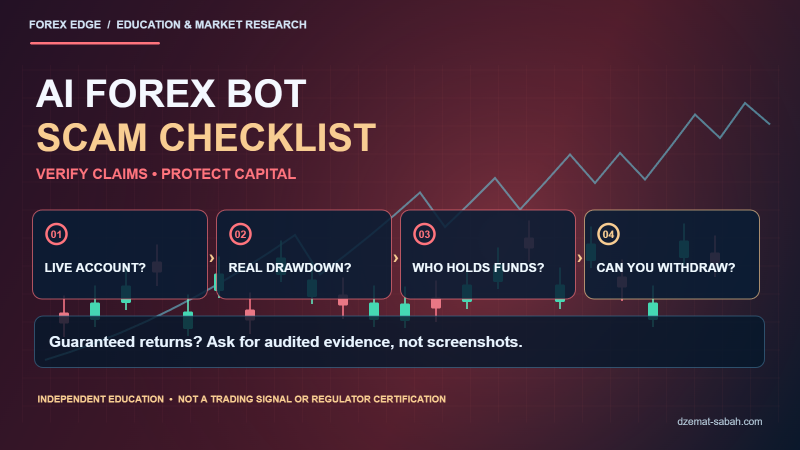
The safest approach is to separate three questions: Does the software exist and do what the seller claims? Does its strategy have reproducible evidence of performance after trading costs? And who receives, controls and is legally responsible for your money? A satisfactory answer to one question does not automatically answer the others. The checklist below is designed to help you ask for evidence and to recognise situations where it is safer not to proceed.
1. A guaranteed-profit claim is not a trading strategy
Currency prices respond to monetary policy, geopolitical developments, economic surprises and changing liquidity. A system can be useful without predicting every market movement, and a genuine trading method must have losing trades, periods of weakness or clearly defined circumstances in which it does not trade. Claims of fixed daily income, ‘100% win rate’, or a risk-free robot powered by a proprietary supercomputer should trigger skepticism.
Ask the provider to define what is guaranteed, by whom and under what binding terms. Avoid making a deposit just to discover that the guarantee means a trial credit, a refund with restrictive conditions, or a figure on a simulated dashboard rather than money available for withdrawal.
2. Distinguish screenshots from third-party account records
A seller can generate an equity curve, a MetaTrader report, or an account balance screen. These images may be genuine or may be edited, selective or demo-only. They do not independently establish the completeness of a trading history. Prefer independently retrievable statements from an identifiable broker and verify whether the records include deposits, withdrawals, costs, floating losses and account changes.
Even a third-party performance page may have limitations in what it verifies. A ‘track record verified’ badge can mean something narrower than an audited financial statement. Ask exactly how trading history was obtained, whether all accounts are included, whether large losing accounts were closed, and whether the provider can explain sudden jumps in equity.
3. Watch the gap between balance and equity
Balance often excludes floating gains and losses on open positions, while equity includes the mark-to-market result. A robot that never closes losing trades may show a smooth balance curve while open positions accumulate a dangerous drawdown. A report that celebrates a 40% realised return but hides a 50% floating loss does not provide a trustworthy picture of capital risk.
Request a curve based on equity and a record of the maximum historical peak-to-trough decline. Ask whether the strategy averages down, uses grids or martingale sizing, or increases position size after losses. Such methods can create long strings of small wins followed by rare, large losses.
4. Compare the claim with trading costs and conditions
A robot’s historical chart may use a zero-spread assumption, instant execution and no commission, while the real account has spread, slippage and overnight financing. For example, suppose a strategy’s gross return after 100 trades is +10R but all-in execution costs amount to 0.15R per trade. Total costs then consume 15R and the net result is −5R. These figures are hypothetical, but the arithmetic illustrates how small repeated fees can reverse a modest edge.
Ask which instruments, broker entities, server times and contract specifications were used. A report from one broker or period should not be marketed as universal profitability for every platform. If the seller will not describe the costs and execution rules, the performance cannot be evaluated responsibly.
5. Look for out-of-sample and forward testing
If a software vendor ran hundreds of optimisations on the same historical period and selected the best outcome, its backtest may fit noise. The evidence should identify separate development and holdout periods, data quality, fees, how missing quotes were handled, and any later rule changes. Forward testing is an additional step, not a substitute for disclosure of the historical test method.
Demo performance can reveal operational problems but is not proof of future live returns. Compare any results to a simple benchmark and ask for both profitable and losing months. A vendor that cannot reproduce its own report with the same data and rules is making a claim that should not be relied upon.
6. Find the real legal entity behind the website
A trading software company, a broker and an investment manager perform different activities. A seller may have a registered company for marketing software but lack permission to hold client funds or manage investments. Likewise, a brand may point to a regulated affiliate while signing your contract through an unrelated offshore entity.
Check the contracting company’s official legal name and jurisdiction. Where relevant, consult the regulator register, such as the FCA’s firm checker for firms claiming UK authorisation, or applicable US regulatory databases. A familiar trading platform name and an attractive logo are not a substitute for legal due diligence.
7. Identify who can move your money
There is a fundamental difference between buying code that runs in a demo account and sending funds to a manager who operates a remote trading account. Some scams require deposits into wallets, accounts or websites controlled by the promoter. Others ask users to install software with extensive remote access to their device. In both cases, the risk includes loss of control over funds or sensitive credentials.
Do not share a trading password, email verification code, device control access or financial documents with a salesperson. If a paid service claims it needs unlimited access to your account for ‘AI optimisation’, ask for a technically limited, revocable permission structure and professional verification.
8. Read withdrawal rules before considering a subscription
Fraudulent sites may fabricate dashboard profits and then demand ‘tax’, ‘verification’, or ‘unlock’ charges before releasing withdrawals. A legitimate financial-service agreement should state the actual withdrawal process, timelines, possible costs and applicable anti-money-laundering requirements before money is deposited. Unexpected transfers to personal accounts or a new third-party wallet are reasons to stop and investigate.
Test the provider’s real identity rather than trusting a screenshot of a payout. If a consumer believes they have been targeted by a scam, they should preserve communications and contact their bank, local authority or relevant regulator through official channels promptly.
9–12. Four more checks that traders often skip
Check (9) whether the seller discloses referral or affiliate compensation, (10) whether reviews can be independently verified rather than fabricated or incentivised, (11) whether the bot uses leverage or concentrated exposure far above your own budget, and (12) whether you can export all transactions and independently reproduce the claimed performance. Treat excuses that this information is a ‘trade secret’ with caution; proprietary code can remain private while measurable risk disclosures are still available.
No screening process removes all counterparty or market risk, but a checklist can prevent urgency and promotional language from replacing evidence. Refusing a trading subscription is often easier than attempting to recover funds after an unauthorised deposit.
A short checklist to use before paying
Write the answer to each question: Who is the contractual provider? Is the product software, brokerage or managed investment? Who holds the money? Is the track record live and complete? Does it report equity and maximum drawdown? Were spread and slippage included? Is the test out of sample? What are the withdrawal rules? Is the company authorised for the service and client location? What happens if the system fails? Can you cancel and retrieve your own records?
Keep this guide with our AI forex research pillar, the forex trading robots overview and the London-session AI strategy case study. A serious trader or investor should be willing to hear how a system loses, not only how it claims to win.
Frequently asked questions
Can a genuine AI trading bot lose money?
Yes. Market price changes, leverage, data errors, slippage and model breakdown can produce losses regardless of the technology used.
Does a third-party verified performance badge guarantee safety?
No. Verification may cover limited facts about the reported history and usually does not guarantee future profitability or the broker’s solvency.
What is the strongest warning sign?
Promises of guaranteed or extraordinary returns without complete, independently checkable performance and clear risk disclosures are especially concerning.
Should I pay another fee to unlock a forex bot withdrawal?
Unexpected additional ‘unlock’, tax or verification payments demanded by strangers should be treated as a potential fraud sign and investigated through official channels.
Official sources and further reading
- CFTC — AI Trading Bots and Fraud
- CFTC — Retail Forex Fraud
- FCA — Forex Trading Scams
- FCA — Check a Firm Is Authorised
- QuantConnect — Research Guide and Overfitting
Notice: Trading carries significant risk. Check current broker contracts, regulatory activity, data timestamps and all execution assumptions. Read the risk disclosure and editorial policy.
About the Author