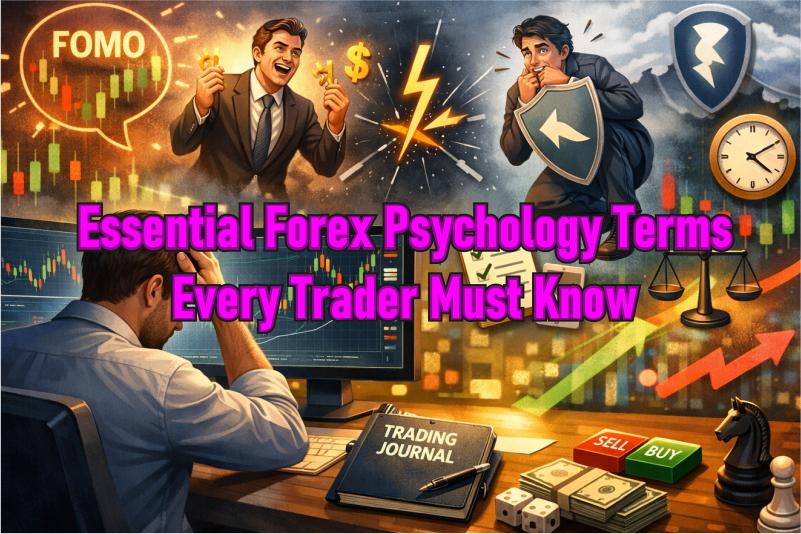
Many forex traders spend months—sometimes years—searching for the perfect strategy: the most accurate indicator, the ideal timeframe combination, or an entry setup that feels “almost guaranteed” to win. Yet, real market experience often proves otherwise. The same strategy can generate solid profits at one time, only to cause a series of losses at another.
From direct experience and close observation of both beginner and intermediate traders, one recurring pattern stands out: the main issue is rarely the trading system—it is the trader’s psychology. Fear when price moves against a position, greed after a winning streak, or the urge to recover losses quickly often destroys even the most carefully designed trading plans.
This is why understanding forex psychology terms is essential. These concepts are not just theoretical ideas; they reflect real mental states that traders face daily when making decisions under uncertainty.
1. Fundamental Psychological Factors in Forex Trading
Forex psychology is closely related to how traders think, feel, and act under pressure. Below are several fundamental psychological concepts that frequently become the root cause of trading mistakes.
Fear
Fear arises when traders are afraid of losing money. Its common effects include:
- Closing profitable trades too early
- Hesitating to enter the market despite valid setups
- Moving stop-loss levels without logical justification
In practice, many traders correctly analyze market direction but fail to maximize profits because fear takes control.
Greed
Greed usually appears after a series of profitable trades. Traders begin to feel invincible and may:
- Overtrade excessively
- Increase position size without proper risk calculation
- Ignore their original trading plan
In one observed case, a trader doubled their account within two weeks but lost most of the gains in a single day simply because they refused to stop when market conditions changed.
Overconfidence
Overconfidence causes traders to underestimate risk. This mindset often emerges after a winning streak, even though the forex market is never 100% predictable.
2. Key Forex Psychology Terms and Practical Ways to Manage Them
Below are some of the most common forex psychology terms traders encounter, along with actionable steps to manage them effectively.
a. FOMO (Fear of Missing Out)
Definition: The fear of missing a trading opportunity when price moves rapidly.
Real-world example:
A trader sees a large bullish or bearish candle and enters impulsively, driven by the fear that “the price is already moving.”
Practical solutions:
- Use an entry checklist before opening any position
- Remind yourself that market opportunities appear every day
- Focus on setup quality rather than trade quantity
b. Revenge Trading
Definition: Emotion-driven trading aimed at recovering previous losses quickly.
Impact:
A small loss can escalate into a significant drawdown.
How to prevent it:
- Limit the number of trades per day
- Stop trading temporarily after consecutive losses
- Record emotional states in a trading journal
c. Analysis Paralysis
Definition: Overanalyzing the market to the point of never executing a trade.
Solutions:
- Limit indicators to a maximum of two or three
- Commit to one primary trading system
- Set a fixed decision-making timeframe
3. Real Case Study: A Strong Strategy Undermined by Weak Psychology
One retail trader observed over several months had a solid trading system: consistent risk-reward ratios of 1:2, stable win rates, and clear risk management rules. However, in execution, the trader frequently:
- Violated stop-loss rules
- Entered trades before valid signals appeared
- Added positions while already in a losing trade
Upon evaluation, the core problem was not strategy—it was emotional pressure caused by fear of being wrong and the desire to recover losses quickly. Once the trader focused on improving mindset rather than changing strategies, performance gradually stabilized. This reinforces a critical truth: psychology is the foundation of trading success, not an optional add-on.
4. Expert Insights and Trusted References
Mark Douglas, a renowned trading psychology expert and author of Trading in the Zone, famously stated:
“The market does not create your emotions; you do.”
Douglas emphasized that losses are a natural part of trading, and successful traders are those who can accept uncertainty without excessive emotional reactions.
Additionally, research published in the Journal of Behavioral Finance indicates that traders who consistently follow a predefined trading plan tend to achieve more stable performance than those who frequently alter decisions based on emotions.
These expert insights confirm that trading psychology is not merely opinion-based—it is a recognized and researched discipline within professional trading.
Conclusion: Master Yourself Before Mastering the Market
Understanding forex psychology terms helps traders realize that the greatest enemy in trading is often not the market, but the trader’s own mindset. Fear, greed, FOMO, and revenge trading are natural human responses—but they must be managed deliberately.
Key solutions to apply immediately:
- Follow a clear trading plan
- Maintain a trading journal to evaluate emotional patterns
- Focus on the trading process rather than instant results
- Accept losses as part of a long-term trading business
If you want to survive and grow in the forex market, start with the most fundamental skill: mastering your trading psychology. Treat mindset as an asset—not an obstacle.
Start today by documenting every trade along with your emotional condition at the time of execution. Within 30 days, you will begin to recognize psychological patterns that may be limiting your trading performance.
About the Author


