Independent educational guide. All numerical examples are hypothetical; this is not a trading signal or investment advice.
An economic-calendar alert pops up: US inflation is higher than economists expected, and EUR/USD begins to move. Traders often reach for the same shortcut: ‘Higher inflation means higher rates, so buy dollars.’ Sometimes the dollar rallies; at other times it fades or moves in the opposite direction. Markets respond to the gap between expectations and new information, but also to revisions, positioning, other parts of the report and what central bankers are likely to do next.
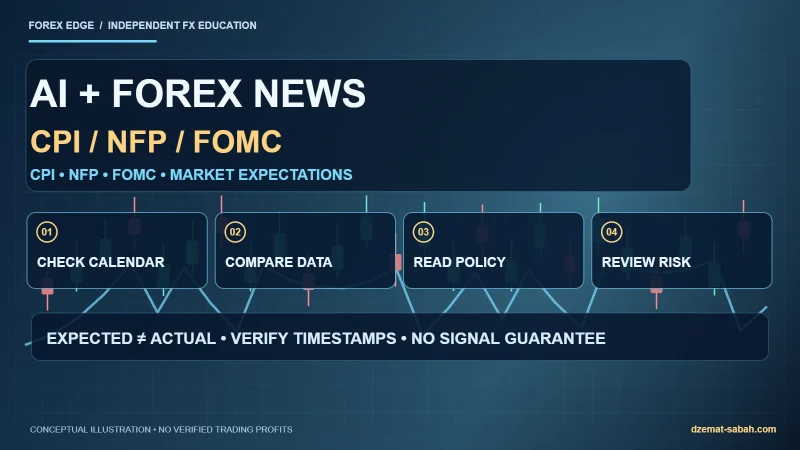
AI can help a trader organise a complicated report, compare it with the previous release and identify questions worth investigating. It cannot decide a safe trade from a single headline. This guide uses the US CPI, the monthly Employment Situation report that contains nonfarm payroll data, and Federal Open Market Committee communications to illustrate a measured workflow. The numerical example is fictional; no trading signals or account performance claims appear here.
Start with the source, not with an AI summary
For US consumer inflation, the Bureau of Labor Statistics publishes the Consumer Price Index (CPI) and maintains an official release calendar. The same agency publishes the Employment Situation report, including payroll employment, unemployment and earnings. The Federal Reserve publishes FOMC statements, meeting dates and minutes. These primary documents tell you what was actually reported, whereas a social-media post may omit revisions or confuse the date of a release with the month to which the figures refer.
Always record the timestamp and the time zone. Many US statistical releases are scheduled at 08:30 Eastern Time; that corresponds to 19:30 WIB while New York observes daylight saving time and 20:30 WIB during standard time. FOMC policy announcements have their own publication schedule. Do not build a robot around the assumption that all economic news appears at the same hour.
What AI should prepare before a CPI release
Before the report arrives, a responsible analysis describes possible scenarios rather than claiming to know the outcome. You can ask a model to explain which CPI components are often watched, what month-over-month and year-over-year measurements mean, and which data fields you should extract from the official release. Record the latest available figures, a clearly sourced market consensus, the scheduled release time and your existing exposure to the US dollar.
Consensus estimates are not supplied by the BLS itself; they come from market surveys or other data providers with their own methodologies. Label their source and capture time. If you cannot obtain a reliable expectation figure, do not invent one. Without that reference, it is misleading to describe a release as a positive or negative surprise in numerical terms.
A fictional example: expected 2.7%, reported 2.9%
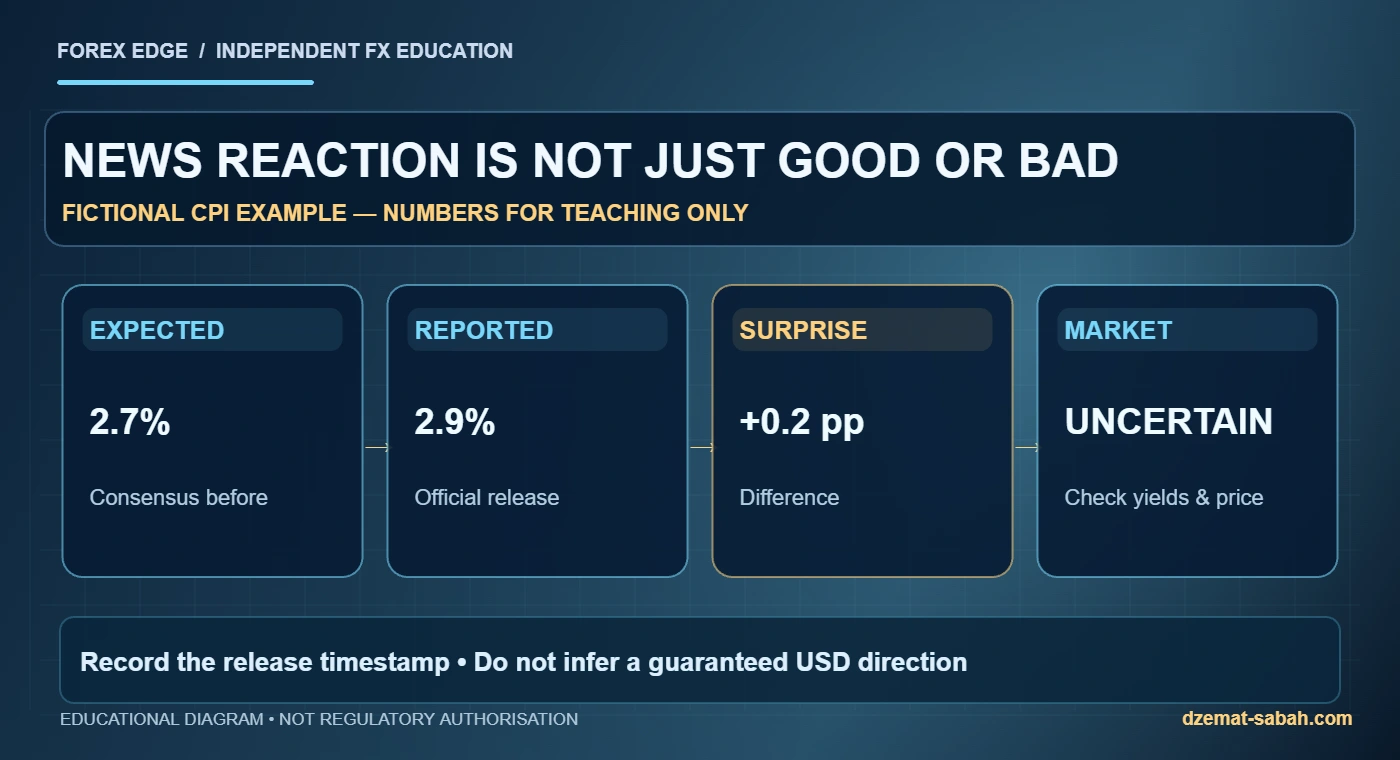
Imagine a hypothetical annual CPI estimate of 2.7% followed by an official value of 2.9%. The difference is +0.2 percentage points, not ‘inflation increased by 0.2%’ in the usual percentage-growth sense. That small distinction matters for accurate notes. An AI assistant can calculate the difference, but the trader must verify both figures and whether they refer to the same series, seasonal adjustment and period.
| Field | Hypothetical number | Research note |
|---|---|---|
| Consensus | 2.7% YoY | Timestamp and source required |
| Reported CPI | 2.9% YoY | Check actual BLS release |
| Surprise | +0.2 percentage points | Not a trading signal |
| EUR/USD response | Unknown | Observe yields, liquidity and pricing |
Why is the currency response unknown? The bond market may already have priced a surprise, another component of the report may contradict the headline, or traders may close crowded positions. The data can also affect perceptions of growth and risk appetite. A strong macro narrative written after the candle moves is not evidence that the move was reliably foreseeable.
NFP is more than the payroll headline
The US Employment Situation release is commonly referred to as NFP because nonfarm payroll employment is a closely watched series. But the report also contains the unemployment rate, participation and wage information, as well as revisions to earlier employment estimates. A preliminary headline can be offset by later details. Asking AI to summarise only the first number is a recipe for a shallow conclusion.
A better prompt is: ‘Using only this official BLS release and its prior release, make a compact comparison of payroll employment, revisions, unemployment and wage indicators; state the publication time; mark any value not present; and distinguish changes in facts from interpretations about Federal Reserve policy.’ Verify the response line by line. If the report includes a major methodology or benchmarking change, note it rather than assuming that this month’s figure is perfectly comparable with last month’s.
FOMC: compare the statement, not just the interest-rate decision
A decision to leave rates unchanged can still move currencies if its accompanying language signals a different outlook from what investors expected. The FOMC statement, economic projections in selected meetings and the chair’s press conference may contain information about inflation progress, labour conditions or the balance of risks. Read the official statement before accepting a summary from a commentator.
An AI assistant can make a two-column textual comparison of the latest statement and its predecessor: what sentences changed, which phrases about inflation or labour disappeared, and what remains uncertain. It should never fabricate a quote, and it must not treat a rhetorical change as proof of the next decision. Market expectations are fluid, and the currency response can depend on bond yields and global news arriving at the same time.
Separate news analysis from order execution
A report can be accurately summarised while a trade remains poorly planned. During a high-impact announcement, spreads can widen, quotes may update quickly and stop orders can fill at different prices from the requested levels. A trade taken because ‘AI says the CPI is bullish’ ignores these execution risks. If your strategy was never tested during releases, standing aside may be more defensible than chasing the first candle.
Before a news event, record open positions, potential losses if stops are reached, aggregate currency exposure and the broker’s margin requirements. Review whether the spread remains within the range assumed in your tests. Later, compare estimated versus actual fills and keep the event context with the trading journal. These details link the research process to real financial risk.
A pair of prompts to use before and after a release
Before: ‘Using the attached official schedule and my sourced consensus table, prepare three scenarios for the upcoming CPI release. Mark each figure’s source, timestamp and series definition. State what I need to verify after publication. Do not predict a guaranteed currency direction or give buy/sell instructions.’
After: ‘Using only the attached official release, compare the actual values, revisions and expectations. Separate facts from hypotheses, identify inconsistencies in the source data and suggest the additional market evidence required before explaining a price move. Do not invent missing numbers.’
This approach is deliberately less exciting than a one-line signal. Its strength is that it can be audited and repeated without pretending that a language model has privileged access to the market. A record of ‘information insufficient’ is often more useful than a confident but untestable directional forecast.
How to make the workflow useful over several months
Build a spreadsheet with columns for release type, expected and actual series, surprise, revisions, publication time, spread before and after, observed EUR/USD or USD/JPY range, and any trade taken. Record the corresponding source URLs. After enough comparable releases, look for descriptive patterns in your own instruments and execution costs. Do not infer a profitable system from two or three dramatic news days.
Use our AI Forex research guide to frame a real test, the fundamentals-versus-technical-signals article to understand setup failure and our surprise-news explainer for additional context. The London session guide and New York session guide help with time zones.
Frequently asked questions
Can AI accurately predict an NFP candle?
No reliable prediction is guaranteed. AI can analyse documented information and scenarios, but surprise data and execution conditions remain uncertain.
Does above-consensus US CPI always strengthen the dollar?
No. The reaction depends on market expectations, report components, positioning, interest-rate perceptions and other factors.
Where can I verify CPI and NFP publication times?
Use the BLS official release calendars and note whether the US is observing daylight saving time.
Should I place an order immediately after an AI-generated news summary?
Not automatically. Verify the release and evaluate the predefined setup, costs, liquidity, leverage and risk before any decision.
Primary sources and further reading
- Bureau of Labor Statistics — CPI release schedule
- Bureau of Labor Statistics — 2026 releases
- Bureau of Labor Statistics — Employment Situation report
- Federal Reserve — FOMC calendars and statements
- CFTC — Retail forex risks
Markets, execution conditions and financial permissions may change. Review the underlying source and your actual contract before acting. Read our risk disclosure and editorial policy.
About the Author