Independent educational analysis. Illustrations are hypothetical, not investment advice or verified trading results.
Finding a low-cost forex broker sounds straightforward until you compare accounts quoting different prices. One may advertise zero commission but a wider spread. Another may offer a narrow spread and a fee per lot. A third might be inexpensive for short EUR/USD transactions but costly for positions held over several nights. A chatbot can organise these figures, but it cannot reliably know a broker’s current prices unless you supply fresh, verifiable information.
This guide shows a way to combine an AI research assistant with an ordinary spreadsheet. We will calculate one hypothetical EUR/USD round trip, identify missing disclosures and build a repeatable comparison that can be checked manually. No real broker is ranked here, and the figures below are deliberately fictional examples; real conditions vary by legal entity, account type, instrument and trading hour.
Start with the same trade, not the same headline
To compare two accounts fairly, hold the trade specification constant: instrument, position size, entry and exit times, order type, holding period and account currency. If Broker A is quoted at the London overlap and Broker B at the weekend reopening, their displayed spreads are not directly comparable. A typical daytime quote also says little about slippage around a major economic release.
An effective worksheet includes the broker’s full legal entity, account type, publication date of its fee schedule, link to contract specifications, bid–ask sample, commission basis and any swap or administrative charge. Keep URLs to primary pricing pages rather than screenshots of affiliate marketing claims. Without consistent inputs, any AI-produced ranking may be precise-looking but economically meaningless.
What is the spread cost?
The spread is the difference between the price at which you can normally buy (ask) and sell (bid). For a standard USD-denominated EUR/USD account, a one-pip move is approximately $10 per 100,000 EUR standard lot, or $1 per 0.10 lot. This approximation follows the common 0.0001 pip convention for EUR/USD; it does not apply unchanged to every pair, CFD or account currency.
If the spread at entry is 1.4 pips for a 0.10-lot EUR/USD position, an illustrative spread cost is about $1.40 under a simple round-trip cost model. The spread can change while the order is open, and additional market movement will affect the actual fill. The important lesson is to calculate the trade value, not simply to record the number of pips printed on an advertisement.
The difference between per-side and round-trip commissions
A broker may quote a commission as $3.50 per standard lot per side, meaning $3.50 to open and $3.50 to close, or $7 for the round trip. Another broker could quote $7 per lot per round trip directly. Confusing these formats creates a twofold error in the comparison. Confirm whether the charge is denominated in the account currency or converted at a separate rate.
For 0.10 standard lot, a $7 round-trip standard-lot commission corresponds to $0.70. Add it to the spread component rather than assuming a zero-spread label means the entire trade is free. Also review minimum-ticket commissions if the provider charges a fixed amount for very small orders.
Worked example: two fictional EUR/USD accounts
Assume Broker A has a 1.4-pip effective spread and no separate commission, while Broker B has a 0.3-pip effective spread plus a $7 commission per full lot round trip. For the same 0.10-lot EUR/USD position with a pip value of approximately $1, Broker A’s simplified cost is 1.4 × $1 = $1.40. Broker B’s simplified cost is 0.3 × $1 + $0.70 = $1.00. The difference is $0.40 per trade before slippage and other charges.
| Cost item | Broker A (fictional) | Broker B (fictional) |
|---|---|---|
| Pair / size | EUR/USD / 0.10 lot | EUR/USD / 0.10 lot |
| Spread | 1.4 pips | 0.3 pip |
| Spread cost | $1.40 | $0.30 |
| Round-trip commission | $0.00 | $0.70 |
| Simple trading cost | $1.40 | $1.00 |
Multiply the example across a hypothetical 80 trades and the apparent difference is $32, but this still does not establish which broker is genuinely cheaper. Execution quality, slippage, price improvement, account conditions and holding fees can change the result. A provider that quotes a lower minimum spread may still have a higher typical all-in cost during the hours you actually trade.
Add slippage and overnight financing carefully
Slippage is the difference between a requested or expected execution price and the actual fill. It may be favourable or unfavourable, but using zero slippage in all historical simulations is often too optimistic. Store actual fills from your own trades or, when historical data are unavailable, test clearly labelled stress scenarios such as 0.2, 0.5 and 1.0 additional pip per round trip.
Swap or rollover charges can accumulate when a position crosses the broker’s daily cut-off; account labels such as Islamic or swap-free may use different administrative fee rules. A strategy that closes in ten minutes may care primarily about spread and commission, while a multi-day strategy may be heavily affected by financing. Compare both the per-trade and the per-day cost instead of compressing everything into one universal broker score.
How AI can help without inventing price data
Ask a language model to standardise the fee schedule you supply. Example prompt: “Using only the broker pricing tables attached, extract the account name, legal entity, currency pair, spread basis, commission per side or round trip, swap method, minimum ticket fee and document date. Flag every missing value. Then produce a spreadsheet-ready comparison for a 0.10-lot EUR/USD trade, showing formulas rather than guessing numbers.”
The most valuable AI output may be a list of missing information. If a commission term is ambiguous, the system should not silently decide it means round trip. If the broker offers no historical spreads, the model should not pretend to calculate a reliable monthly average. Check copied values against the source documents and recalculate key cells independently.
Spreadsheet formulas you can reproduce
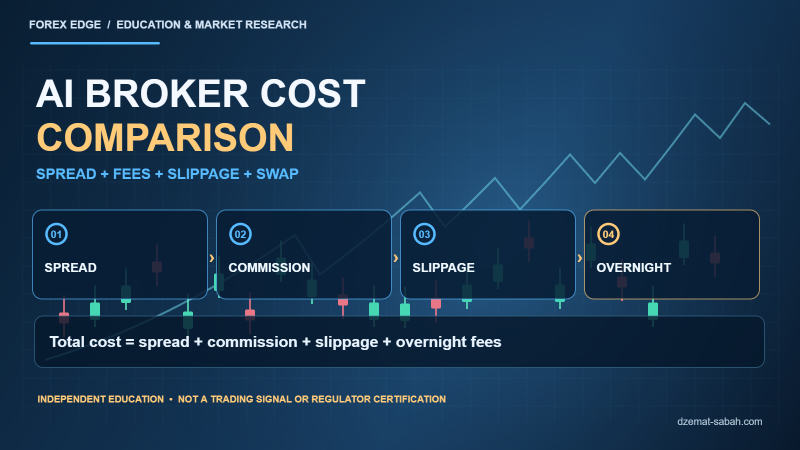
Set pip value in USD per lot at a given instrument and account currency, then derive the pip value for the chosen volume. In a simplified case: pip value for position = pip value per standard lot × number of lots. Spread cost = spread in pips × pip value for position. Commission cost = round-trip commission per standard lot × lots. Total estimated dealing cost = spread cost + commission + assumed slippage cost, plus any financing and conversion fees.
Be cautious about different contract sizes and pip definitions. If comparing USD/JPY in a USD account or a gold CFD, the pip calculation and currency conversion can change materially. This is precisely why a spreadsheet should make unit conversions explicit. Ask AI to inspect the spreadsheet for inconsistent units, but treat your platform’s symbol specification as the source of record.
A cost-aware broker selection also needs regulation
Low dealing cost does not compensate for an unverified counterparty. Before moving money, match the name of the legal entity in the account contract to the appropriate regulator’s register and check the authorisation activities and complaint route. An attractive zero-commission claim is irrelevant if the provider’s withdrawal terms are opaque or its marketing promises conflict with the official permissions.
For more background, read how brokers determine spreads, fixed versus floating spread, and the AI forex research pillar. The AI bot warning guide explains how misleading performance claims can bypass basic due diligence.
The final comparison should be transparent, not a prediction of profit
Publish or store the exact date of the quotes, trading hours, instrument, trade size, pip value, fee definitions and missing assumptions. When prices change, update the worksheet rather than copying last year’s conclusion. Do not allow a model to calculate a broker ranking from anonymous testimonials or a mixture of account types that no customer can actually combine.
Even the cheapest broker does not make a losing trading method profitable. Cost reduction can improve a strategy’s net expectancy, but it does not create an advantage by itself. Trading carries substantial risk, particularly when leverage magnifies both ordinary price moves and abnormal market gaps.
Frequently asked questions
Can ChatGPT find the cheapest forex broker in real time?
Not reliably without fresh, authenticated pricing data from each provider. A model can organise current source documents but should not invent live spreads or commission terms.
Is a zero-commission forex account always cheaper?
No. Wider spreads, financing charges and execution differences may outweigh the absence of a separate commission.
What is the difference between round-trip and per-side fees?
Per-side fees apply separately to opening and closing a position; round-trip quotes include both sides. Confirm the wording before comparing.
Should I choose a broker solely by spread?
No. Compare the legal entity, regulatory permissions, withdrawal terms, execution quality and all relevant costs.
Official sources and further reading
- CME Group — Introduction to FX Markets
- CFTC — Retail Forex Risk Advisory
- FCA — How to check a financial firm
- QuantConnect — Reality Modeling, Fees and Slippage
Notice: Trading carries significant risk. Check current broker contracts, regulatory activity, data timestamps and all execution assumptions. Read the risk disclosure and editorial policy.
About the Author