In forex trading, many traders believe the key to success lies in finding the right indicator. They experiment with combinations of oscillators, moving averages, and custom tools, hoping one setup will finally unlock consistency. Yet despite all the signals, confusion often grows rather than fades.
The reason is simple: indicators do not move the market. Supply and demand do.
Price in the forex market is driven by the imbalance between buyers and sellers. Indicators only react to price after that imbalance has already occurred. Understanding supply and demand in forex trading allows traders to shift their focus from prediction to participation—aligning with how the market actually works.
Understanding Supply and Demand in Forex Trading
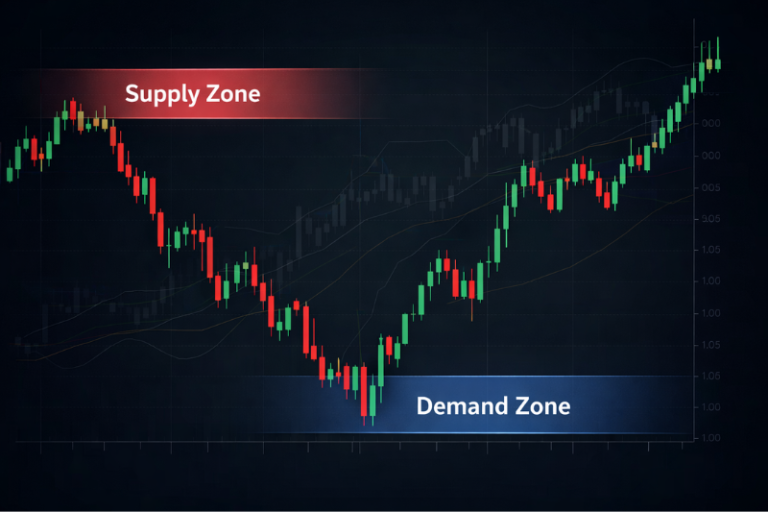
Supply and demand in forex refer to price areas where significant buying or selling pressure previously entered the market. These areas are often visible as strong impulsive moves, where price left a zone rapidly with little resistance.
A demand zone forms when buyers aggressively push price higher, indicating strong interest at that level. A supply zone forms when sellers dominate, causing price to drop sharply. These zones are not just technical drawings; they represent real decisions made by large market participants.
Unlike indicators, which are recalculated every candle, supply and demand zones are structural. They remain relevant until price decisively breaks through them.
How Supply and Demand Drive Forex Price Action
Forex price action becomes clearer when viewed through the lens of supply and demand. Every trend, reversal, or consolidation begins with an imbalance between orders.
When demand exceeds supply, price must rise to find sellers. When supply overwhelms demand, price must fall to attract buyers. This constant search for balance explains why price reacts repeatedly at certain levels.
Traders who rely solely on indicators often miss this context. They see signals without understanding where those signals occur. In contrast, supply and demand trading emphasizes location first, timing second.
Institutional Influence and Supply and Demand Zones
One of the most important reasons supply and demand matter more than indicators is institutional behavior. Banks and large financial institutions cannot enter or exit positions instantly. Their order sizes require liquidity, which is often found at previous supply and demand zones.
This is why price frequently reacts strongly when revisiting these areas. What retail traders perceive as “support and resistance” is often better understood as institutional supply and demand zones.
Indicators do not reveal institutional intent. Supply and demand do.
Why Indicators Lag Behind Market Structure
Indicators are derived from historical price data. Whether momentum-based or trend-following, they summarize what has already happened. This lag becomes problematic during fast market moves or sudden reversals.
In ranging markets, indicators often generate conflicting signals. In volatile conditions, they react too late. This creates a cycle of late entries and emotional exits.
Supply and demand analysis, by contrast, focuses on where price is likely to react, not on chasing confirmation after the fact. It provides a framework for understanding market structure before a trade is even considered.
Supply and Demand vs Indicators in Forex Trading
The debate between supply and demand vs indicators is not about choosing one and discarding the other. The difference lies in hierarchy.
Supply and demand define the battlefield. Indicators can help fine-tune execution within that battlefield.
When traders invert this relationship—using indicators to decide direction without market structure—they trade symptoms instead of causes. This is why many strategies work temporarily but fail over time.
A price action approach grounded in supply and demand creates clarity. Indicators, when used sparingly, simply support decision-making rather than dominate it.
The Real Advantages of Supply and Demand Trading
One of the strongest benefits of supply and demand trading in forex is clarity. Entries are based on price reaching a meaningful area, not on multiple indicators aligning by chance.
Risk management also improves naturally. Supply and demand zones provide logical areas for stop-loss placement, making risk-to-reward ratios more favorable and consistent.
Because supply and demand apply across all timeframes, traders can scale the same concept from intraday trading to swing trading without changing their core strategy.
Common Misunderstandings About Supply and Demand
Many traders struggle with supply and demand not because the concept is flawed, but because it is misunderstood. Drawing too many zones, ignoring higher-timeframe context, or treating every zone as equal weakens its effectiveness.
Supply and demand require selectivity. Strong zones are defined by clear imbalance, clean price departure, and minimal prior testing. Without these characteristics, zones lose significance.
Understanding this nuance separates mechanical zone-drawing from true market reading.
Using Indicators the Right Way with Supply and Demand
Indicators are most effective when they confirm reactions at supply and demand zones rather than predict them. For example, momentum slowing near a supply zone or volume increasing at a demand zone can add confidence—but they should never replace structural analysis.
In this framework, supply and demand remain the foundation, while indicators serve as secondary tools. This approach reduces noise and encourages disciplined, rule-based trading.
Final Thoughts: Build Your Forex Strategy on Supply and Demand
Forex trading becomes simpler when you stop searching for the perfect indicator and start studying how price actually moves. Supply and demand reveal the forces behind every candle, every breakout, and every reversal.
By prioritizing supply and demand over indicators, traders gain context, clarity, and consistency. Indicators may decorate a strategy, but supply and demand should define it.
When you understand where real buying and selling take place, the market stops feeling random—and starts making sense.
About the Author