Remember that initial rush when you started trading? There was a sense of excitement, the adrenaline of analyzing the market, and the hope of achieving financial freedom. Over time, however, that feeling might have faded.
Instead of enthusiasm, you might feel anxiety every time you open your trading platform. Instead of a challenge, you feel a burden. If this resonates with you, this article is for you.
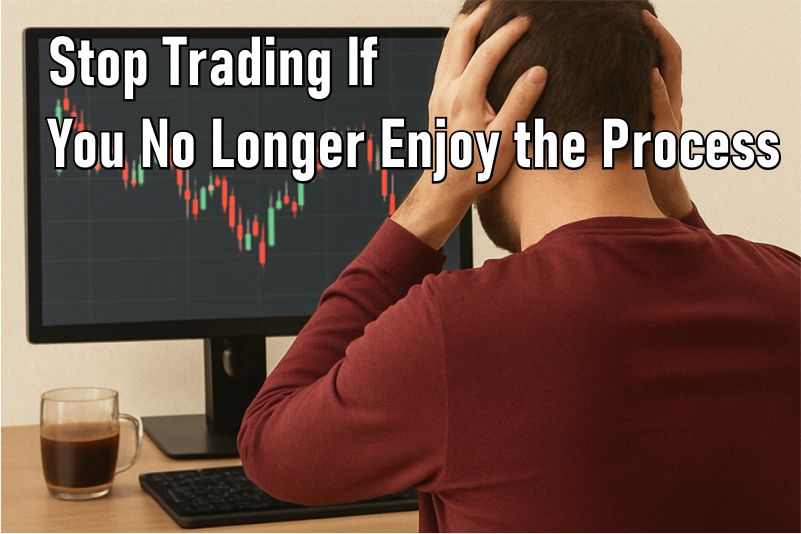
Many say trading is a marathon, not a sprint. But what if you’re out of breath halfway through? We often ignore one crucial aspect: mental health. The decision to stop trading if you don’t enjoy the process isn’t a failure—it’s often the most *strategic* trading decision you can make.
Why “Enjoying the Process” is Crucial in Trading
Trading, at its core, is a game of probability and emotional management. You cannot control the market, but you can control your reaction to it.
When you no longer enjoy the process—or at least, can no longer tolerate its stress in a healthy way—your self-control will be the first casualty.
- Discipline Declines: You’ll be more likely to break your trading plan, over-trade, or revenge-trade after a loss.
- Irrational Decisions: Chronic stress (from not enjoying the process) is scientifically proven to impair cognitive function. You’re more likely to make impulsive decisions rather than analytical ones.
- Loss of Objectivity: You start “hoping” the market moves your way, instead of reacting objectively to what the market is showing you.
Successful trading requires a clear and calm mind. If the process itself has become a source of acute stress, you’re effectively trading against yourself.
5 Real Signs You’re Experiencing Trading Burnout
Trading burnout is a state of emotional, mental, and physical exhaustion caused by prolonged stress from trading. It’s a strong signal that you may need to re-evaluate, take a break, or even stop trading.
Here are the primary signs:
1. Trading Feels Like a Burden, Not a Challenge
You used to be enthusiastic about researching your watchlist over the weekend. Now, you procrastinate on opening your charts. If trading feels like draining forced labor instead of a motivating challenge, this is one of the clearest signs of trading burnout.
2. Emotions Take Over (Revenge Trading & Acute FOMO)
Do you often get angry at the market? Or feel panicked (FOMO) at the slightest price movement? If you find yourself:
- Revenge trading (trying to “get back” at the market after a loss).
- Entering the market without a clear analysis, just for fear of missing out.
- Feeling severely depressed on a cut loss and overly euphoric on a small win.
This indicates you’re failing at managing your emotions in trading. You’re no longer trading; you’re gambling emotionally.
3. Ignoring Your Trading Plan
Your trading plan is your anchor. When you start consciously ignoring it—”Ah, just this once I’ll ignore my stop loss,” or “This looks like a sure thing, I’m going all-in”—you’ve lost your discipline. This often happens because you’re too mentally exhausted to stick to the rules you set for yourself.
4. Declining Physical and Mental Health
Pay attention to your body. Are you experiencing this?
- Difficulty sleeping (insomnia) or restless sleep because you’re thinking about a floating loss.
- Increased headaches, stomach issues, or muscle tension.
- Becoming easily irritable or withdrawing from social activities.
Financial health is meaningless if it’s exchanged for ruined physical and mental health.
5. Obsessing Over Charts Outside of Trading Hours
Checking crypto prices in the middle of the night? Opening your stock app while at dinner with family? If you can’t “switch off” from the market even when you’re supposed to be resting, your trading psychology is in trouble. You are no longer controlling your trading; your trading is controlling your life.
The Dark Side of Trading Psychology: When a Hobby Becomes an Addiction
Many traders don’t realize they are addicted, not disciplined. The constant act of trading releases dopamine (the “reward” hormone) in your brain, similar to gambling.
When you “win,” you get a high. When you “lose,” you want to jump back in to get that dopamine hit again. This process is mentally exhausting. This separates passion (enjoying the analytical process) from compulsion (being forced to chase the sensation).
If you no longer enjoy the learning process—the analysis, risk management, and evaluation—and are only chasing the “high” of a profit, you are on the fast track to burnout.
“Stop Trading” Doesn’t Mean Failing: It’s a Strategy
So, what should you do if you recognize these signs? When should you stop trading?
Deciding to stop or pause is a risk management strategy for your most important assets: your capital and your mental health.
Option 1: Take a Break from Trading
This is the most common first step.
- What to do: Close all your positions (or at least don’t open new ones). Log out of your trading apps.
- How long: Set a clear timeframe. It could be one week, one month, or even three months.
- The goal: To clear your head, break the stress cycle, and regain perspective. Use this time for other hobbies, exercise, or spending time with loved ones.
Option 2: Recalibrate
If, after taking a break from trading, you still feel the urge to return, don’t just jump back in.
- Review Your Journal: Look back at your trading journal. Where were your mistakes? Were they technical, or purely emotional?
- Reduce Your Risk: Return to the market with a much smaller capital (e.g., 30% of your usual) or use a demo account.
- Focus on the Process: Change your goal. Not “to make X% profit,” but “to execute 10 trades according to my plan with perfect discipline.”
Option 3: Quitting Completely
This is the most feared option, but often the most liberating. Ask yourself honestly:
- Does trading truly suit my risk profile and personality?
- Am I willing to sacrifice this much time, energy, and stress?
- Are there other, more passive investment methods that are a better fit (e.g., index funds, long-term investing)?
Stopping trading completely isn’t a sign that you’ve ‘failed’ or are ‘bad’ at it. It’s a sign of emotional maturity—that you recognize what isn’t working for you and are brave enough to make a decision to protect your well-being.
Conclusion: Listen to Your Body and Mind
The market will always be there tomorrow, next week, and next year. Opportunities are not going away. But your mental health and your capital, once depleted by burnout, are much harder to recover.
If you feel you need to stop trading if you don’t enjoy the process anymore, listen to that signal. Whether it means taking a break to recharge or stopping completely to find a more peaceful path to investment, both are valid decisions.
The best trading is the kind that lets you sleep soundly at night.
About the Author