Table of Contents
The most expensive mistake in gold trading is not always choosing the wrong direction. Sometimes you read the market correctly, enter too late, place the stop too close, or commit more capital than the opportunity deserves.
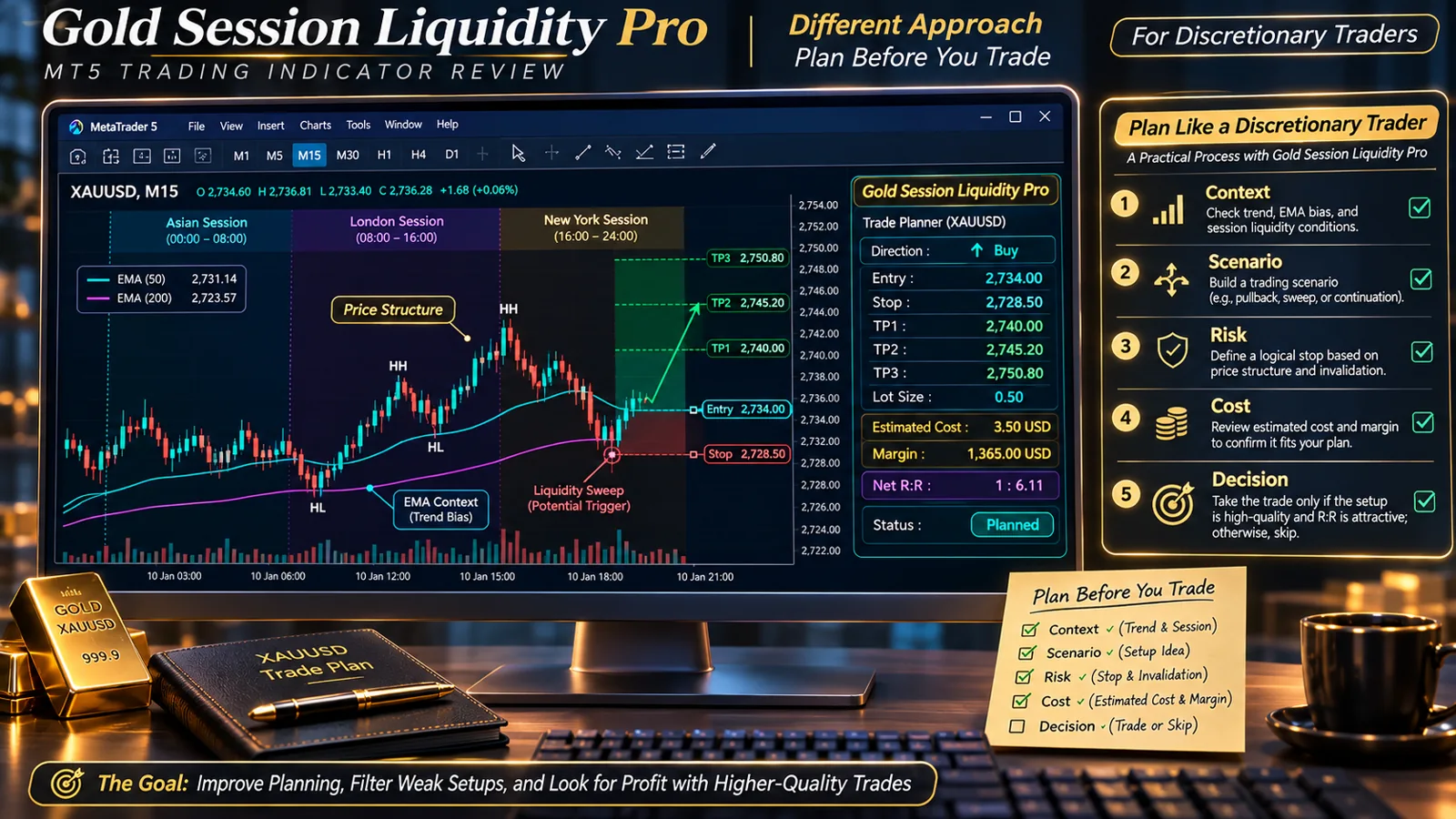
That is why another buy-and-sell indicator may not be the answer. Gold Session Liquidity Pro for MetaTrader 5 takes a different approach: it brings market context and position planning together, allowing you to examine the economics of a potential XAUUSD trade before risking money.
Instead of asking whether gold will rise or fall next, the more useful question becomes: is this particular trade worth taking at this particular price? That distinction is the focus of this review.
A different way to think about gold trading indicators
Most traders are familiar with the cycle. A signal appears, price starts moving, and the temptation to enter grows. The stop and position size are often decided afterward. Unfortunately, a good directional idea is not necessarily a good trade.
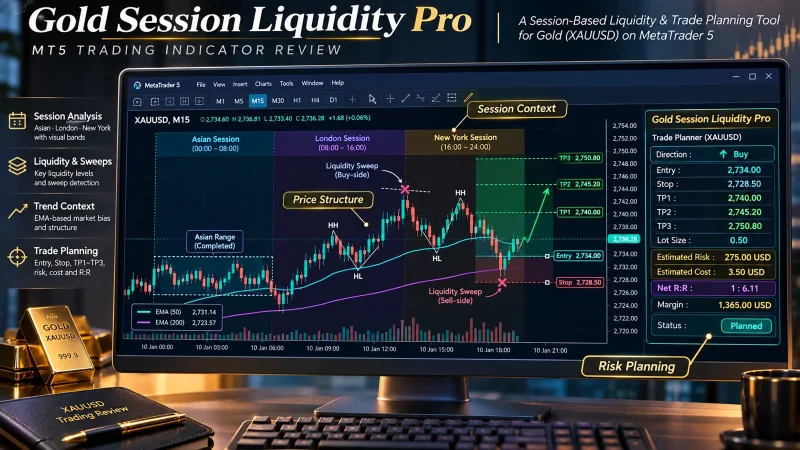
Gold Session Liquidity Pro is designed as an analytical and planning indicator for MT5 desktop, not an automated trading system. Its published specifications describe session context, EMA-based trend information, price structure and a planner that estimates the risk and cost of a proposed position.
A trader can choose a buy or sell scenario, or use the automatic trend-based planning direction. None of these choices places an order. The final decision remains with the trader.
Approach 1: Trade the rejection, not the first breakout
Gold frequently attracts attention when price approaches a previous session high or low. An initial break beyond a range can be followed by either continuation or rejection. The problem is that both possibilities can look similar in real time.
Suppose the Asian range has completed and London trading pushes XAUUSD below its earlier low. Rather than immediately selling the breakout, observe whether price returns inside the range. If the broader trend is bullish, a recovery above the reference level may provide a reason to study a long scenario.
Use the indicator’s session and price-based sweep context alongside your own reading of completed candles. Define a point where the idea is invalidated, then assess the stop distance and estimated position size. If the required stop is too wide for the available reward, skip the setup.
Importantly, a sweep label is a price observation, not proof that institutional orders were collected. The indicator cannot see a centralized gold order book or predict that a reversal will follow.
Approach 2: Compare continuation and pullback entries
Trend followers often face a familiar dilemma: enter immediately when momentum is strong, or wait for a pullback and risk missing the move.
The default automatic planning context uses completed H1 EMA 20 and EMA 50 information on an M15 chart. This provides a higher-timeframe reference rather than relying solely on the current candle. The trader can then investigate alternative entry prices using the manual planning options.
In version 1.40, the published specifications describe holding a scenario and moving entry or stop lines to explore hypothetical prices. Targets adjust to the revised stop distance. That makes it possible to compare the implications of two entry ideas without actually opening either position.
A pullback is not automatically preferable. It can offer a better entry price but may never occur, or it may develop into a genuine reversal. A breakout can work well when momentum persists, but the risk of paying a worse price must be considered.
Approach 3: Reject trades that fail the numbers
This may be the most overlooked application of the indicator. A setup can look excellent on a chart while its cost-adjusted reward remains unattractive.
Consider two hypothetical trades with an identical $50 price-risk budget. Assume $4 of total round-trip trading costs for each and a binary outcome in which the full target or full stop is reached. The following figures are illustrations, not indicator test results.
| Planning measure | Setup A | Setup B |
|---|---|---|
| Gross potential reward | $75 | $125 |
| Gross potential loss | $50 | $50 |
| Estimated trading costs | $4 | $4 |
| Net potential reward | $71 | $121 |
| Net potential loss | $54 | $54 |
| Net reward-to-risk | 1.31:1 | 2.24:1 |
| Break-even win rate | 43.2% | 30.9% |
Setup B has a more favorable payoff profile, but it is not necessarily more profitable. A more distant target may be reached less frequently. The point is to assess the relationship between the payoff and the probability of success rather than treating the reward-to-risk ratio as a prediction.
Gold Session Liquidity Pro provides estimates for position volume, trading costs, margin and net reward-to-risk. Broker-specific commission and slippage assumptions must be reviewed; gaps, unexpected execution costs and other real-world conditions can make actual results worse.
Why profitability depends on more than the next signal
A useful way to judge any trading approach is through expectancy: average winning trade multiplied by win rate, less average losing trade multiplied by loss rate. Use actual net outcomes after costs when calculating this figure from a trade journal.
For instance, an illustrative strategy that wins 40% of the time and averages a $100 net win and a $50 net loss has an expectancy of $10 per trade. The same strategy becomes unprofitable if the average win shrinks sufficiently or losing trades become larger.
The role of a planning indicator is to make assumptions visible. It cannot supply a reliable win probability or prove that a strategy has positive expectancy. Testing an entry method across different market conditions remains essential.
How to use Gold Session Liquidity Pro on MetaTrader 5
- Open an XAUUSD M15 chart in MT5 desktop using your broker’s exact symbol name, including any suffix.
- Attach the indicator and allow chart and higher-timeframe history to load.
- Review broker server time, risk settings, commission and slippage assumptions. The published default planning risk is 0.50% of equity; it is a starting assumption, not a universal recommendation.
- Observe the session range and higher-timeframe trend context. Define the trade idea and its invalidation level.
- Choose the scenario direction, review the proposed entry, stop, targets, volume, costs and margin, and check the planner status.
- Use a demo environment and journal the outcome. Take note of skipped trades as well as executed ones.
Pay attention to WAIT and BLOCKED statuses, which indicate unavailable data or conditions preventing an estimate. An available estimate is not a trade recommendation. Verify the broker’s symbol specification and order preview independently.
For the installation process, settings and dashboard interpretation, see this detailed Gold Session Liquidity Pro MT5 user guide. The guide covers an earlier release; use the official listing for current version details.
Who is this indicator best suited to?
Its strongest appeal is to discretionary gold traders who already understand market structure but want a more consistent decision process. Intraday traders can use session ranges as reference points, while risk-conscious traders can compare hypothetical plans before deciding whether to execute.
It is less suitable for anyone seeking an automatic trading robot, guaranteed entries or a verified profitable strategy straight out of the box. The published working scope primarily describes XAUUSD M15 on a USD demo account. Compatibility with every broker and account currency should not be assumed.
Verdict: A tool for choosing trades, not chasing them
Gold Session Liquidity Pro is interesting because it changes the order of decisions. Instead of starting with an entry signal and working backward to justify it, you begin with market context, define the trade’s invalidation, examine the costs and only then decide whether the opportunity deserves your capital.
That approach will not remove losing trades. It may, however, help traders avoid entering without a clearly defined plan and make their trading process easier to evaluate over time.
Explore Gold Session Liquidity Pro on MQL5 Market for the official feature list, current availability and any available trial options. Also read our guide to reviewing a trading plan and our discussion of why XAUUSD behaves differently from major currency pairs.
Editorial disclosure: This feature-based review covers a product from a related trading-tools project. It is not an independent live profitability test. Illustrations are conceptual mockups, not actual platform captures, live quotes, verified calculations or trading signals. Leveraged gold trading involves substantial risk, and losses may exceed planned amounts.
About the Author