Independent editorial guide | Reviewed 10 October 2026 | For education, not personalised investment or legal advice.
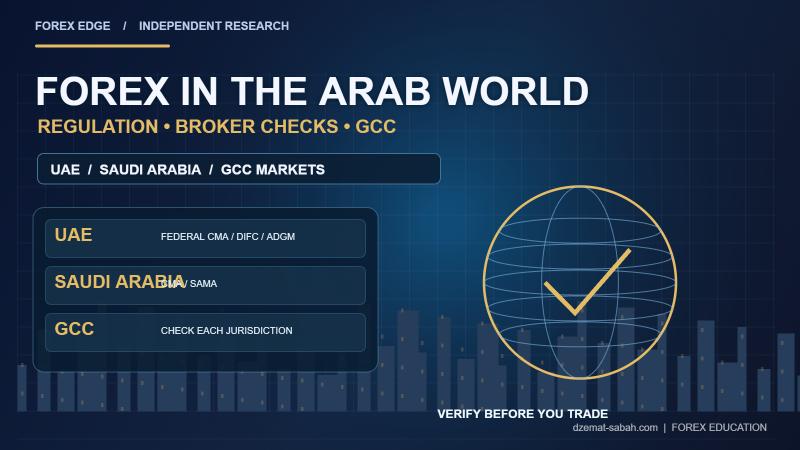
“Forex trading in the Arab world” sounds like one market, but it describes several jurisdictions, several kinds of financial products, and very different relationships between a trader and a service provider. A foreign-exchange counter at a bank is not the same as leveraged retail currency speculation through an overseas CFD platform. A financial free-zone licence does not automatically mean a company may solicit customers in every country of the Gulf Cooperation Council (GCC). For someone choosing a broker, these differences matter far more than a generous bonus.
This guide is a practical regional map, not a list of brokers that we endorse and not a legal conclusion about what residents of every country may trade. It explains how to identify the contracting entity, use official regulatory registers, distinguish physical currency exchange from margin derivatives, and decide which documents to examine before opening an account. Laws, permitted activities and product classifications can change, so the official register and the regulator responsible for the proposed transaction should always be checked at the time of use.
Why regional interest in forex does not prove the size of retail demand
The GCC has international financial centres, substantial cross-border business, active remittance networks and a population familiar with exchange rates. Those factors help explain why currency markets receive attention, but they do not provide an audited figure for how many residents trade leveraged retail forex. Search-engine demand, social media promotion and the size of international bank FX turnover measure different things.
The Bank for International Settlements conducts a global survey of institutional foreign-exchange activity. That is useful context for the worldwide FX market, but it should not be relabelled as the value of retail trading by investors in Dubai, Riyadh or Doha. A rigorous market study would need comparable country-level data about licensed firms, regulated accounts, product turnover and complaint statistics, with explicit coverage limits.
The most important distinction: currency exchange, forex spot, futures and CFDs
Buying USD banknotes, exchanging SAR into EUR for travel, and taking a leveraged EUR/USD position through a CFD are not identical legal or economic actions. A bank or money-exchange service may be supervised under banking or payment rules. Investment firms and derivatives providers may be subject to securities, capital-market or specialised financial-centre regulation. Some platforms present a simulated ownership of the underlying currency but actually settle differences in cash.
Before comparing brokers across countries, write down the exact instrument, the legal entity offering it, where it is incorporated, whether the service is marketed to residents of your country, and the rule that authorises that activity. Do not infer permission to trade a derivative from a money-changing licence or from a broker website that displays a familiar regulator’s logo.
UAE: federal CMA, Dubai DIFC’s DFSA and Abu Dhabi ADGM’s FSRA
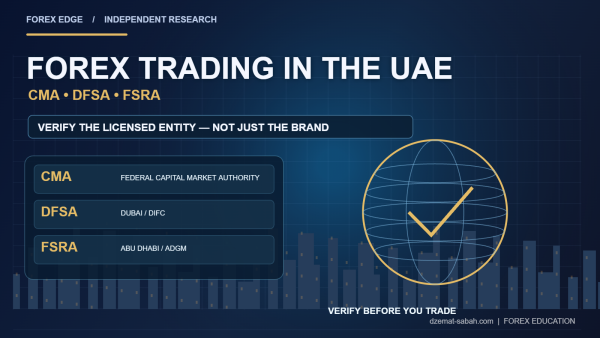
The United Arab Emirates has a multi-layered financial ecosystem. The federal Capital Market Authority (CMA)—the current branding associated with the former Securities and Commodities Authority, or SCA—publishes licensed-company and warning resources. The Dubai Financial Services Authority (DFSA) regulates financial services conducted in or from the Dubai International Financial Centre (DIFC). Abu Dhabi Global Market (ADGM) has its own Financial Services Regulatory Authority (FSRA) and public register.
These regimes are not interchangeable. A DFSA authorisation for a firm to advise particular clients does not automatically establish permission to deal in every leveraged forex product or to market that product to a retail client outside the DIFC. Likewise, an ADGM financial-services permission should be read by activity and legal entity. For a focused checklist, see our UAE forex broker-verification guide.
Saudi Arabia: start with CMA and Saudi Central Bank warnings
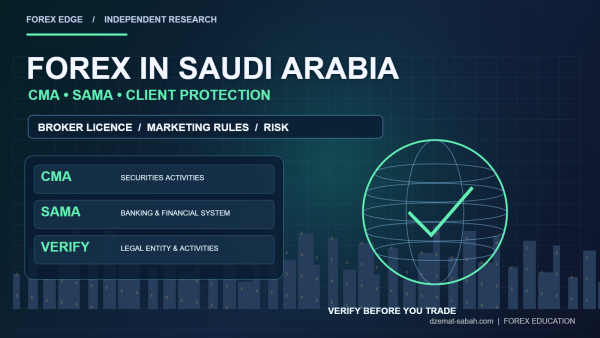
The Saudi Capital Market Authority (CMA) publishes lists of licensed persons and warnings about unauthorised securities activities. The Saudi Central Bank (SAMA) also addresses the use of local banking channels by non-resident forex companies and unlicensed intermediaries. These are important primary sources for understanding the difference between regulated local activity and a foreign website that accepts account applications from Saudi residents.
A firm supervised overseas cannot be assumed to have Saudi authorisation simply because it offers SAR deposits, Arabic-language customer support or Islamic-account marketing. The appropriate question is whether the exact financial service offered to you is permitted for the relevant client and entity. Read the source guidance and our Saudi forex compliance and risk guide before drawing conclusions.
Bahrain, Kuwait, Qatar and Oman: a practical verification map
Investors in Bahrain can start with the Central Bank of Bahrain (CBB), the regulator for a wide range of financial institutions and investment services. Kuwait’s Capital Markets Authority (CMA) publishes licensed firms and a non-exhaustive list of unlicensed entities for regulated securities activities. In Qatar, the Qatar Financial Centre Regulatory Authority (QFCRA) supervises permitted activities in the Qatar Financial Centre; the Qatar Central Bank has a separate institutional role. Oman’s Financial Services Authority (FSA) regulates sectors within its mandate, distinct from the central bank’s banking responsibilities.
Do not transfer the legal analysis of a broker from one of these countries to another. A company could have permission for investment advice in one financial centre while lacking permission for online OTC derivatives marketed to another country’s residents. Use the regulator’s searchable register and, if unclear, its official contact channel. Avoid a review site’s generic ‘regulated in the GCC’ badge as a substitute for an activity-by-activity verification.
Five documents to collect before transferring money
First, obtain the exact client agreement and identify the legal entity and jurisdiction. Second, match its company registration and the specific financial activity against the official regulator register. Third, read the risk disclosure and contract specification for the currency pair or CFD. Fourth, locate the full price schedule: spread, commission, financing, account fees and withdrawal or currency-conversion charges. Fifth, establish the customer-service and dispute route and whether it applies to residents of your location.
Be particularly careful with platforms promising fixed monthly profits, instant doubling of funds or ‘AI signals’ that supposedly cannot lose. An affiliate commission may influence a promoter’s enthusiasm; insist on knowing who pays for a recommendation. A demo platform is useful for learning order entry but does not show the precise live liquidity or remove counterparty risk.
Islamic or swap-free accounts: what a label can and cannot tell you
Some providers offer a ‘swap-free’ account, meaning that the ordinary overnight interest or rollover charge is replaced, removed or modified according to their terms. That does not answer whether the underlying contract involves real currency delivery, a CFD, leverage, financing or other terms relevant to a customer’s religious assessment. Administrative fees or holding-period conditions may remain.
Legal compliance and Sharia assessment are different questions and both depend on details. Our Arabic guide to Islamic swap-free accounts explains practical contractual questions without issuing a blanket religious ruling. A qualified adviser can review the actual documents for your circumstances.
Practical next steps for traders and researchers
Choose a country and an instrument first, then identify the competent regulator and search by the counterparty’s legal name, not just its brand. Verify the permission scope and whether local-client marketing is permitted. Compare actual dealing costs, margin and withdrawal policies, and document the risks of gaps and forced liquidation. Only after those questions are resolved should you consider whether the product is financially appropriate.
The easiest contribution AI can make here is organisational: it can turn a long client agreement into a list of claims to verify, but it cannot prove a licence that you have not checked. Read our AI Forex research pillar and the broker regulation checklist to apply this framework consistently. This website is an independent educational publication, not a local regulator or the official website of any broker.
Frequently asked questions
Is forex legal in every Arab country?
There is no single legal answer for all countries or all products. The permission depends on the exact instrument, service, jurisdiction, provider and customer category.
Does a UAE licence permit a broker to solicit investors across the GCC?
Not automatically. The licence and authorised activities have a specific scope; cross-border solicitation rules must be evaluated in each location.
Where should I verify a broker’s licence?
Start with the official register of the regulator responsible for the contracting entity and check the precise licensed activities, company name and current status.
Is a swap-free account automatically Sharia compliant?
No. The label addresses only some account terms. Contract type, settlement, financing, fees and other conditions should be reviewed separately.
Official sources and further reading
- UAE Capital Market Authority — public open-data and licensed companies
- Dubai Financial Services Authority — DFSA
- ADGM — Financial Services Regulatory Authority (FSRA)
- Saudi Capital Market Authority — licence and warnings
- Saudi Central Bank — non-resident FOREX company guidance
- Kuwait CMA — list of licensed companies
- Kuwait CMA — unlicensed companies
- Central Bank of Bahrain
- Qatar Financial Centre Regulatory Authority
- Oman Financial Services Authority
- Bank for International Settlements — 2025 FX survey
Disclosure: Forex and leveraged CFDs carry substantial risk of loss. A broker authorisation must be checked by legal entity and service, and no algorithm or trading system guarantees results. This is not an endorsement of a broker, regulator or investment product. Read our risk disclosure and editorial standards.
About the Author