Every trader dreams of a strategy that can lock in profits while still giving room for bigger gains. Enter the trailing stop strategy—a tool often praised as the secret weapon for disciplined trading. But as with many tools in the financial markets, the big question lingers: Is it really an effective strategy, or just a comforting myth?
Let’s explore this together in a relaxed, story-like journey through the world of trailing stops.
What is a Trailing Stop?
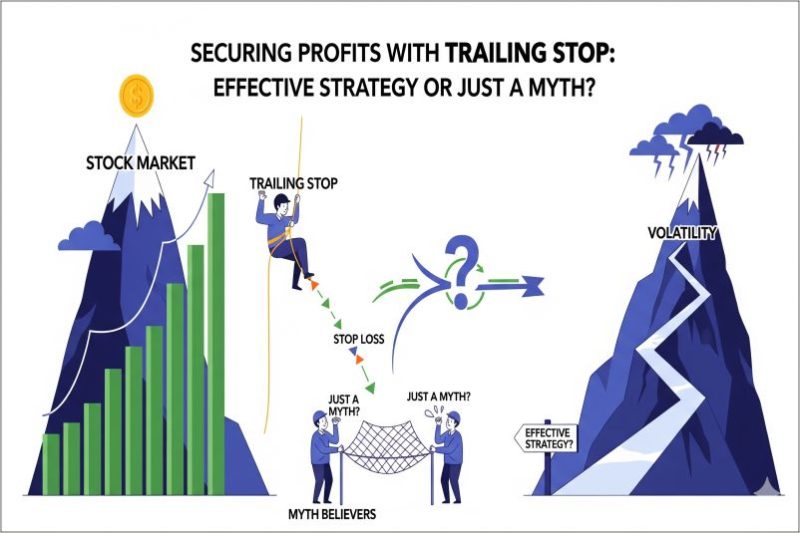
Imagine you’re hiking up a mountain, and every time you climb a few meters higher, someone moves your safety net higher as well. If you slip, you won’t fall back to where you started—you’ll only drop to the last safe level. That’s exactly how a trailing stop in trading works.
Unlike a fixed stop-loss, which stays at one price level no matter what, a trailing stop moves along with the market in your favor. If the market goes up, the stop goes up. If the market falls, the stop stays where it is, protecting your gains.
This dynamic movement is why many traders see it as a flexible way to secure profits with trailing stop without constantly staring at the charts.
Why Traders Use Trailing Stops
Trading is as much about psychology as it is about strategy. Fear and greed often get in the way of rational decisions. Many traders find trailing stops comforting because:
- They reduce emotional interference—no need to second-guess when to exit.
- They protect profits automatically, even while you sleep.
- They let your winning trades “breathe” and grow instead of being cut short.
Think of it as a loyal assistant who’s always on watch, tightening the rope whenever you move higher, but never loosening it when things go down.
The Advantages of the Trailing Stop Strategy
When used wisely, the trailing stop strategy can be a trader’s best friend. It offers several advantages:
- Flexibility: Unlike static stop-loss orders, trailing stops adapt to the market.
- Profit protection: Once the market has moved in your favor, profits are gradually locked in.
- Supports discipline: By automating exit decisions, traders avoid impulsive choices.
- Best in trending markets: When the price moves in strong trends, trailing stops allow traders to ride the wave without worrying about giving back all their gains.
For instance, in a strong forex uptrend, setting a trailing stop a few pips below market price could mean catching a big ride upwards while knowing you’ll still walk away with profits if the trend suddenly reverses.
The Limitations and Risks
But let’s be honest—nothing in trading is perfect. And while trailing stops may sound like the golden key, they do come with challenges.
- Premature exits: If your trailing stop is set too tight, even normal market noise can knock you out before the real move begins.
- Volatile markets: In markets like cryptocurrencies or oil, rapid fluctuations can trigger trailing stops too often.
- False security: Many beginners believe trailing stops guarantee profits. In reality, if the market never moves far enough in your favor, the trailing stop may only protect small gains—or worse, none at all.
In short, a trailing stop doesn’t magically remove risk. It’s just another tool that needs to be handled with care.
When Trailing Stops Work Best
So, when does the trailing stop in trading truly shine?
- Trending markets: They’re most effective when the market is moving strongly in one direction.
- Swing trading: Holding trades for days or weeks allows trailing stops to capture big moves.
- Risk management: Combined with sound position sizing, they can form a reliable safety net.
Imagine catching a stock rally where the price climbs steadily. With a trailing stop, you don’t have to guess the top. The stop trails behind, letting you stay in the trade until the market itself decides it’s time to exit.
When Trailing Stops Can Fail
On the flip side, is trailing stop effective in sideways or choppy markets? Not really.
If the price keeps bouncing up and down in a tight range, your trailing stop might get triggered over and over again, cutting you out for tiny gains or even repeated small losses. It can also fail if you set the distance without considering volatility. Too close, and you’re out too soon. Too far, and you risk losing a bigger chunk before locking in profits.
Alternatives and Enhancements
Does this mean you should abandon trailing stops? Not at all. But many experienced traders don’t rely on them alone. Instead, they enhance the trailing stop strategy with:
- Manual adjustments: Actively moving stop-losses as new support/resistance levels form.
- Partial profit-taking: Closing part of the trade to secure gains while letting the rest run.
- ATR-based trailing stops: Using Average True Range (ATR) to adjust stop distance based on volatility.
- Indicator-based methods: Combining trailing stops with moving averages or price patterns.
By blending these methods, traders create more adaptive exit strategies that fit their personal style.
Trailing Stops: Strategy or Myth?
So, back to the question: is the trailing stop strategy an effective way to secure profits, or just a myth traders like to believe in?
The truth lies in the middle. Trailing stops are neither a guaranteed money-maker nor a useless gimmick. They’re a tool—powerful in the right hands, problematic in the wrong ones.
Used properly, they can help traders ride big waves while sleeping peacefully at night. Misused, they can chop you out of trades before you’ve had a chance to taste real profits.
Conclusion
In the end, securing profits with trailing stop comes down to context and discipline. It’s not about whether trailing stops work universally, but whether they fit *your* trading strategy, market conditions, and risk appetite.
So, is it an effective strategy or just a myth? It’s definitely a strategy—but only if you test it, fine-tune it, and use it with a clear understanding of its strengths and weaknesses.
Like every tool in trading, the trailing stop is not the holy grail. It’s simply another rope in your safety harness. The real climb is still yours to make.
About the Author