The idea of making money in the forex market without constantly watching charts sounds incredibly appealing. Imagine a system that analyzes the market, opens trades, manages risk, and closes positions automatically while you focus on other things.
This is exactly what EA Forex, also known as an Expert Advisor, promises.
Over the last decade, automated trading systems have become extremely popular. Many traders are attracted to the concept of robot trading forex, especially beginners who feel overwhelmed by complex charts and fast market movements.
But the big question remains:
Can EA Forex really generate consistent profit?
The short answer is yes—but not in the way many advertisements suggest. Like any trading tool, EA Forex has advantages, limitations, and risks. To understand whether automated trading is truly worth it, we need to explore how these systems actually work.
What Is EA Forex?
EA Forex stands for Expert Advisor, which is essentially a piece of software designed to automate trading decisions in the forex market.
An Expert Advisor Forex runs on trading platforms such as MetaTrader 4 and MetaTrader 5.
Once activated, the EA follows a predefined set of rules written in its algorithm. These rules determine when the system should:
- open a trade
- close a trade
- set stop loss levels
- set take profit targets
- manage open positions
In other words, EA Forex acts like a virtual trader executing strategies automatically.
For many traders, the biggest attraction of automated trading is the idea that the system can operate continuously without human intervention.
However, the performance of an EA depends entirely on the strategy programmed inside it.
How Does EA Forex Work in Trading?
To understand the potential of robot trading forex, it helps to see how an EA actually works behind the scenes.
The process is surprisingly straightforward.
First, the EA Forex reads market data such as price movements, indicators, and trading signals. Then it applies its algorithm to interpret the market conditions.
Once certain criteria are met, the EA automatically executes a trade.
For example, imagine an EA programmed with a simple moving average crossover strategy.
When a fast moving average crosses above a slow moving average, the EA opens a buy position. When the opposite happens, it opens a sell position.
Everything happens automatically.
This ability to follow strict rules without hesitation is one of the key reasons why many traders experiment with automated forex trading.
But automation alone does not guarantee success.
The market itself is constantly changing, and even the best algorithm cannot perfectly predict every movement.
The Advantages of Using EA Forex
Despite the skepticism surrounding trading robots, EA Forex does offer several real benefits when used correctly.
One of the most obvious advantages is the ability to trade 24 hours a day.
The forex market operates across different time zones, and it is impossible for a human trader to monitor charts constantly. An Expert Advisor Forex can scan the market and execute trades even while you sleep.
Another important benefit is the removal of emotional bias.
Many trading mistakes come from fear, greed, or hesitation. A trader may exit a trade too early due to panic, or hold a losing position because of hope.
An EA Forex system, however, follows its programmed strategy without emotions. It does not second-guess itself or deviate from its rules.
Execution speed is another advantage. In fast-moving markets, even a small delay can affect the entry price. Automated systems can execute orders in milliseconds.
Finally, consistency is something EAs excel at.
A human trader might abandon a strategy after a few losing trades. A robot, however, continues applying the same logic every time.
This consistency can be beneficial when the trading strategy itself is well designed.
The Risks and Limitations of EA Forex
While EA Forex trading robots offer convenience, they also come with significant risks that traders should understand.
One of the biggest limitations is that no algorithm can adapt perfectly to every market condition.
The forex market can shift between trending and ranging phases, and strategies designed for one environment may fail in another. An EA optimized for trending markets might struggle when the market becomes sideways.
Another common issue is over-optimization, often referred to as curve fitting.
Some developers design EAs that perform extremely well in historical backtests but fail in live trading. This happens because the algorithm is overly tuned to past data instead of real market behavior.
There is also the risk of large drawdowns, particularly with EAs that use aggressive strategies such as grid trading or martingale systems. These strategies may produce frequent small profits but can lead to massive losses during strong market trends.
Technical dependency is another factor to consider.
Since an Expert Advisor Forex runs on software and servers, problems like internet interruptions, platform errors, or server downtime can disrupt trading activity.
For this reason, many traders use Virtual Private Servers (VPS) to ensure their EA runs continuously.
Can EA Forex Really Generate Profit?
Now we return to the central question: Can EA Forex truly make money?
The honest answer is yes—but only under certain conditions.
An EA Forex system can generate profit if the underlying strategy is sound and the risk management is properly designed. However, expecting a robot to produce guaranteed profits without supervision is unrealistic.
The forex market is influenced by countless variables: economic news, geopolitical events, market sentiment, and liquidity changes. No algorithm can predict everything.
In reality, most professional traders treat EA Forex as a trading tool, not a magic solution.
They monitor performance, adjust parameters when necessary, and combine automated systems with their own market analysis.
When used this way, automated trading can become a powerful component of a broader trading strategy.
When Is EA Forex Most Useful?
Although EA Forex trading is not a guaranteed path to profit, there are situations where it can be particularly useful.
For traders who have a clear and rule-based strategy, an EA can automate execution and reduce the need to manually place trades.
It is also helpful for traders who cannot watch the market constantly. Since forex operates around the clock, an automated system can capture opportunities that might otherwise be missed.
Another practical use is strategy testing.
With the help of an EA, traders can run backtests and forward tests to evaluate how a trading system performs under different market conditions.
This process helps refine strategies before risking real capital.
Tips for Choosing a Good EA Forex
Because of the growing popularity of robot trading forex, the market is filled with thousands of EAs promising incredible profits.
Unfortunately, many of these systems rely on unrealistic marketing claims.
If you are considering using an EA Forex, there are several things you should evaluate carefully.
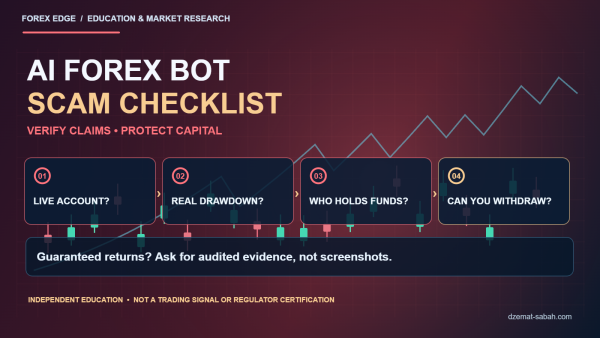
First, look for a transparent performance track record. Reliable developers usually provide verified trading results rather than screenshots.
Second, be cautious of systems promising guaranteed profits or extremely high returns. In trading, such claims are rarely credible.
Third, examine the risk management logic within the EA. A good automated system includes stop-loss rules and sensible position sizing.
Finally, test the EA in a demo account before using it with real money.
This allows you to observe how the system behaves under live market conditions without risking capital.
EA Forex vs Manual Trading: Which Is Better?
The debate between EA Forex trading and manual trading has been ongoing for years.
Both approaches have strengths and weaknesses.
Manual trading offers flexibility. Human traders can interpret market news, sentiment shifts, and unusual patterns that algorithms may not recognize.
On the other hand, automated trading systems provide consistency and speed. They execute strategies precisely as programmed without emotional interference.
In reality, many experienced traders combine both methods.
They use EA Forex for systematic strategies, while relying on manual analysis for broader market decisions.
This hybrid approach allows traders to benefit from the strengths of both human judgment and algorithmic precision.
Conclusion
The growing interest in EA Forex and automated trading is easy to understand. The possibility of trading without constant screen time is attractive to many people.
However, it is important to approach robot trading with realistic expectations.
An Expert Advisor Forex is not a money-printing machine. It is simply a tool that executes a predefined strategy automatically.
Profitability ultimately depends on the quality of the strategy, proper risk management, and continuous monitoring.
For traders who understand these principles, EA Forex can become a valuable part of a disciplined trading system.
But like any tool in the financial markets, success always depends on knowledge, patience, and responsible risk management.
About the Author