If you’ve been trading forex long enough, you’ve probably experienced this moment.
You open a position.
Everything looks normal.
But somehow, your trade starts deeper in the negative than usual.
No dramatic price spike.
No breaking news alert.
Just a slightly wider gap between buy and sell.
That small gap? That’s the spread.
And sooner or later, every trader asks the same question:
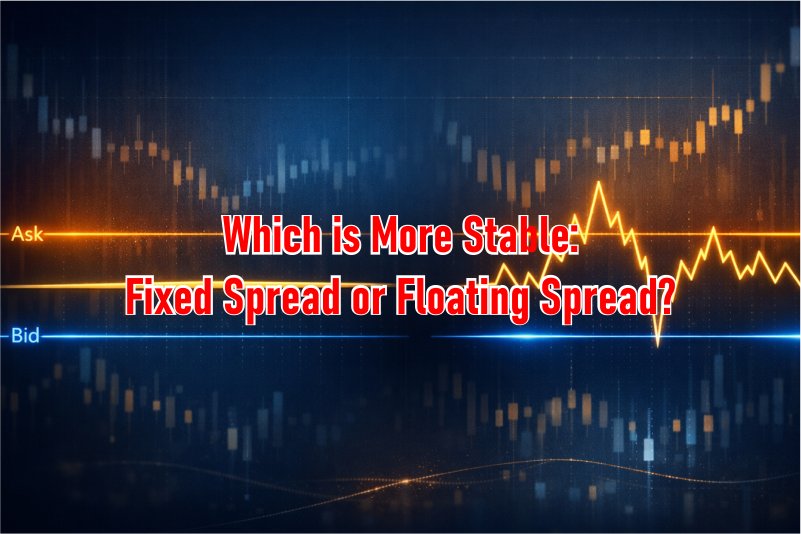
Is fixed spread or floating spread more stable?
At first glance, the answer seems obvious. Fixed sounds stable. Floating sounds unpredictable. But in real trading conditions, the reality is more nuanced — and far more interesting.
Let’s walk through it step by step.
Understanding Spread in Forex Trading
Before comparing fixed spread vs floating spread, we need to clarify what spread actually is.
In forex trading, spread is the difference between the Bid price (sell price) and the Ask price (buy price).
For example:
- EUR/USD Bid: 1.1050
- EUR/USD Ask: 1.1052
The 2-pip difference is the spread.
That spread represents your transaction cost. It’s the fee you indirectly pay to enter a trade. Every position starts slightly negative because of it.
Now here’s where things get important.
Not all spreads behave the same way.
Some are fixed.
Some are floating.
And that difference affects your trading cost, risk management, and even your psychology.
What Is a Fixed Spread?
A fixed spread is exactly what it sounds like: a spread that remains constant regardless of market conditions.
If your broker offers EUR/USD with a 2-pip fixed spread, it stays 2 pips whether the market is calm or volatile.
That consistency is what attracts many beginner traders.
Why Fixed Spread Feels Stable
When you use a fixed spread account:
- You can calculate risk precisely.
- Your stop loss and take profit planning feels predictable.
- You don’t experience sudden cost surprises.
From a psychological standpoint, fixed spread trading reduces uncertainty.
And in trading, reducing uncertainty often reduces emotional mistakes.
The Trade-Off Behind Fixed Spread
But stability comes with a cost.
In normal market conditions — when liquidity is high and volatility is moderate — floating spreads might shrink to 0.5–1 pip.
Meanwhile, your fixed spread might still sit at 2 pips.
That means over time, you could be paying more.
So while fixed spread is stable, it is not always the cheapest option.
What Is a Floating Spread?
A floating spread (also called a variable spread) changes dynamically based on market conditions.
When liquidity is high, spreads tighten.
When volatility increases, spreads widen.
This model is commonly used in ECN or STP accounts, where prices come directly from liquidity providers.
Why Floating Spread Can Be More Efficient
During normal trading hours:
- EUR/USD might have a 0.6 pip spread.
- GBP/USD might stay under 1 pip.
For active traders, especially scalpers, this difference matters significantly.
A smaller spread means:
- Faster break-even.
- Lower transaction costs.
- More room for short-term strategies.
In stable market conditions, floating spread can actually be more cost-efficient than fixed spread.
The Real Question: What Does “Stable” Really Mean?
When traders search for “fixed vs floating spread which is more stable”, they usually mean one of three things:
- Stable cost
- Stable performance
- Stable psychology
Let’s examine each.
Stable Cost
If stability means “the number doesn’t change,” then fixed spread clearly wins.
But if stability means “lower average trading cost over time,” floating spread might be more stable — assuming you avoid high-impact news events.
Stable Performance
If your strategy relies on tight entries (like scalping), floating spread may produce more consistent performance due to lower cost per trade.
If your strategy involves holding trades for days, spread size may become less relevant.
Stable Psychology
For many traders, sudden spread widening during news releases creates panic.
Seeing a 1-pip spread jump to 8 pips can shake confidence — especially for beginners.
In that sense, fixed spread feels emotionally more stable.
Why Do Floating Spreads Widen?
This is where many traders misunderstand the market.
Spreads widen during:
- Major economic news releases
- Interest rate announcements
- Low liquidity sessions (such as rollover time)
- Unexpected geopolitical events
Liquidity providers widen spreads to manage risk during uncertainty.
So when you see floating spread expanding, it’s not manipulation — it’s market protection.
Understanding this makes floating spread less “scary” and more logical.
Fixed Spread vs Floating Spread in Different Strategies
Let’s move beyond theory and talk strategy.
Scalping Strategy
Scalpers aim for small, quick profits — often just 5–10 pips.
In this case, spread size directly impacts profitability.
Floating spread is usually better because:
- It’s tighter in normal conditions.
- It reduces entry cost.
But scalpers must avoid trading during news events when spread widening can erase profit margins.
Day Trading
Day traders hold positions for several hours.
Spread still matters, but not as critically as in scalping.
Both fixed and floating spreads can work — depending on trading hours.
Swing Trading
Swing traders target 50–200 pips or more.
At this level, the difference between a 1-pip and 2-pip spread becomes minor.
Strategy execution and market direction matter more.
News Trading
Here’s where floating spread becomes risky.
During events like Non-Farm Payroll (NFP) or central bank rate decisions, floating spreads can widen dramatically.
If you trade news frequently, fixed spread might provide more cost predictability — though execution speed also matters.
Common Mistakes When Choosing Spread Type
Many traders choose based on marketing phrases like:
- “Lowest spread broker”
- “Zero spread account”
But here’s what actually matters:
- Average spread, not minimum spread
- Commission fees (especially on ECN accounts)
- Slippage frequency
- Execution quality
- Broker regulation
A floating spread of 0.2 pips with high commission may cost more than a 1.5-pip fixed spread without commission.
Spread alone does not tell the whole story.
A Practical Comparison Scenario
Let’s imagine two traders.
Trader A uses fixed spread at 2 pips.
Trader B uses floating spread averaging 0.8 pips.
Both place 100 trades per month.
Over time, Trader B likely pays significantly less — assuming they avoid volatile news periods.
But if Trader B trades during major announcements and faces 7–10 pip spreads, the advantage disappears.
So again, the answer depends on behavior.
So… Which Spread Is More Stable?
Here’s the honest answer:
If you value predictability – Fixed spread feels more stable.
If you value cost efficiency – Floating spread may be more stable over time.
Stability is not universal.
It’s contextual.
And it’s personal.
Final Thoughts: Choose Based on Strategy, Not Fear
Spread is more than just a number on your trading platform.
It defines:
- Your break-even level
- Your cost structure
- Your risk-to-reward calculation
Choosing between fixed spread and floating spread should not be emotional.
It should be strategic.
Ask yourself:
- Do I trade during news releases?
- Is my strategy short-term or long-term?
- Am I comfortable with temporary cost fluctuations?
The best spread is not the one that sounds stable.
It’s the one that aligns with your trading behavior.
Because in trading, consistency does not come from the spread alone.
It comes from understanding how it works — and using it wisely.
About the Author